
Drones & accessories — US
Ring Drone Cam: Amazon's indoor drone launches in the United States
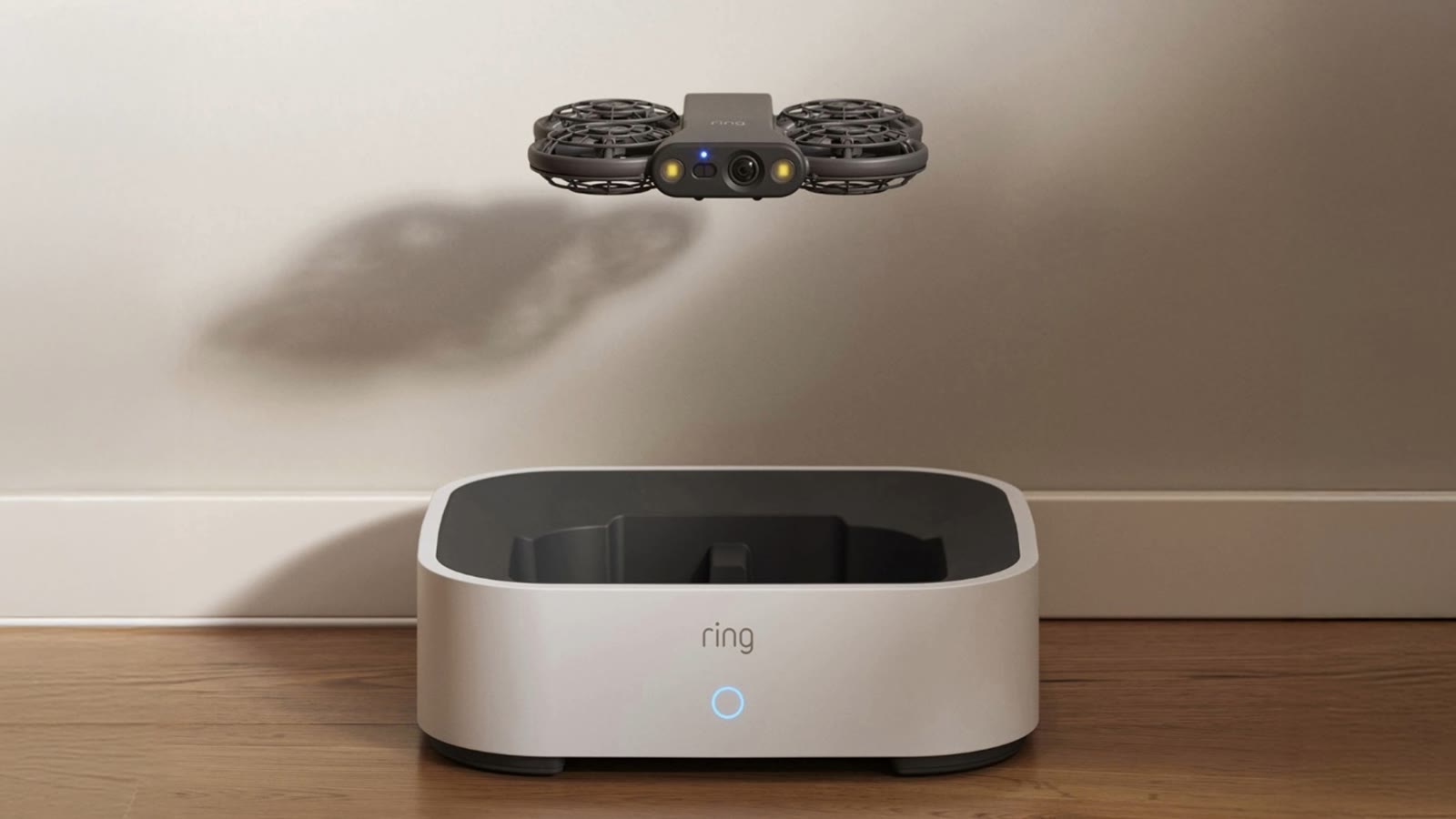
Ring, Amazon's smart-home subsidiary, unveiled on 10 November 2026 a surveillance drone that takes off inside a house to go and see what triggered an alarm. The Ring Drone Cam is announced at $249.99, with deliveries in the United States from 27 January 2027, subject to FCC authorisation that has not yet been granted. No European timetable has been communicated.
What Ring is announcing, figures to back it up
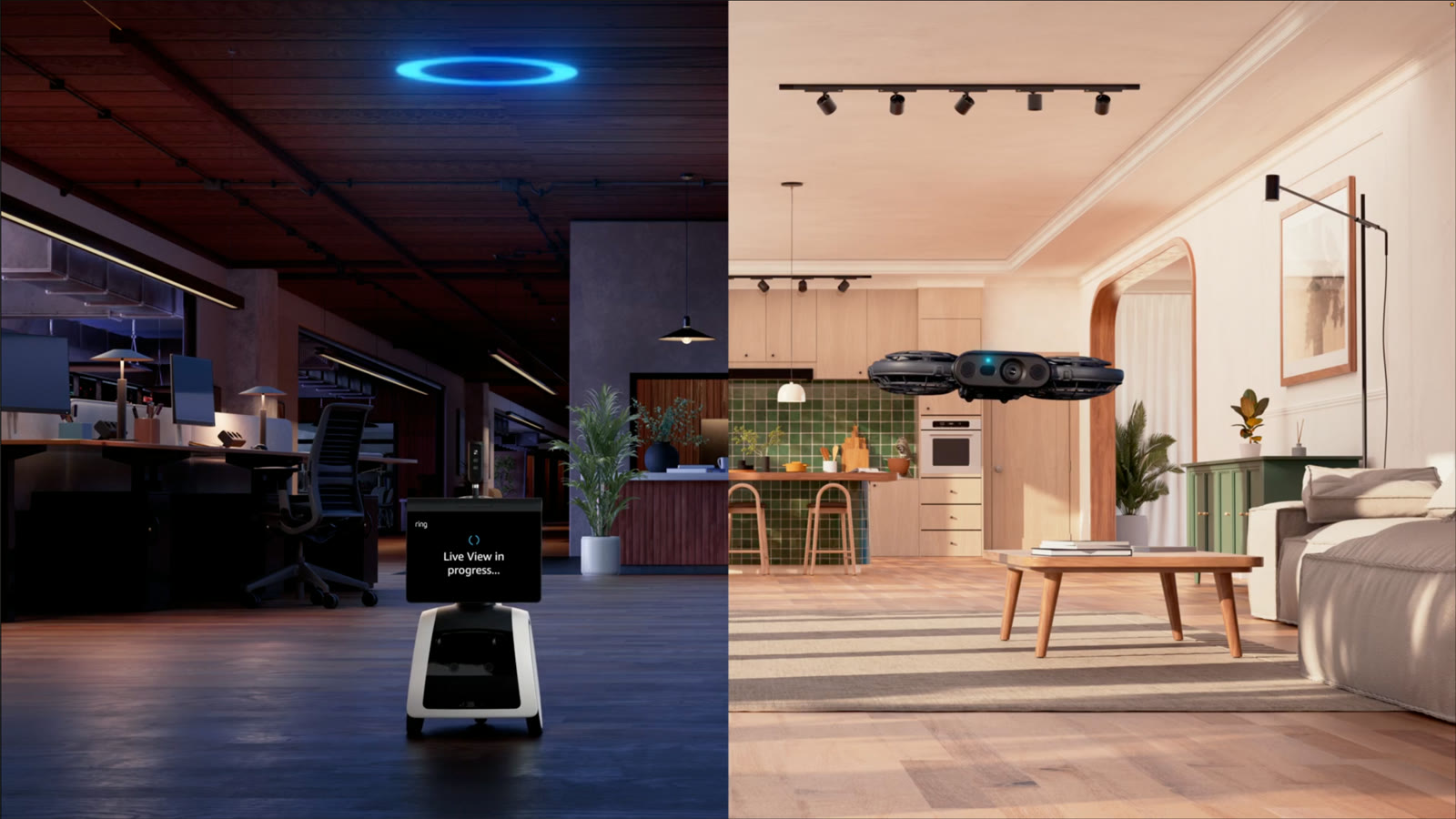
The product is a quadcopter weighing 165 g including the battery, measuring 17.2 × 13.7 × 3.3 cm, resting on a charging station measuring 27 × 23.4 × 7.8 cm. It carries a 2K front camera at 1920 × 1920, a 148° horizontal and vertical field of view, 360° rotation and a 1080p camera under its belly.
Two LEDs light the room in low light and serve as a deterrent at night. A detail worth noting for domestic use: there is neither a microphone nor a speaker, so no intercom.
| Feature | Ring Drone Cam |
|---|---|
| Price (United States) | $249.99 |
| Mass | 165 g, including battery |
| Dimensions | 17.2 × 13.7 × 3.3 cm (station: 27 × 23.4 × 7.8 cm) |
| Camera | 2K 1920 × 1920, 148° H/V field of view, 360° rotation, 1080p downward-facing sensor |
| Audio | None (neither microphone nor speaker) |
| Claimed battery life | About 8 minutes (new battery, controlled conditions) |
| Recharging | About 8 minutes of charging per minute of flight |
| Connectivity | Wi-Fi 2.4 and 5 GHz, WPA2/WPA3, 5 Mbit/s uplink recommended |
| Conditions | Indoor only, 5 to 35 °C, single level |
| Subscription | Ring Protect required for scheduled patrols and storage |
Navigation relies on AI Pilot, Ring Robotics' in-house system. During setup, the user walks the drone from room to room so that it builds a floor plan, then the app suggests patrol points near doors, windows and hallways. In flight, it goes around furniture on its own. It interfaces with Alexa Home Map, unveiled by Amazon the previous month: a point designated on the 3D map is enough to trigger the trip.
The intended uses come down to three situations: a scheduled patrol when no one is home, automatic take-off when a Ring sensor is triggered (motion, door opening, water leak, alarm), and on-demand inspection from the app. Ring is selling the replacement of a cluster of fixed cameras with a single mobile device, with a check round before leaving for the weekend. With eight useful minutes, these are one-off checks, not continuous surveillance.
The limits: eight minutes of flight and blind spots
Intelligence that lives in the cloud
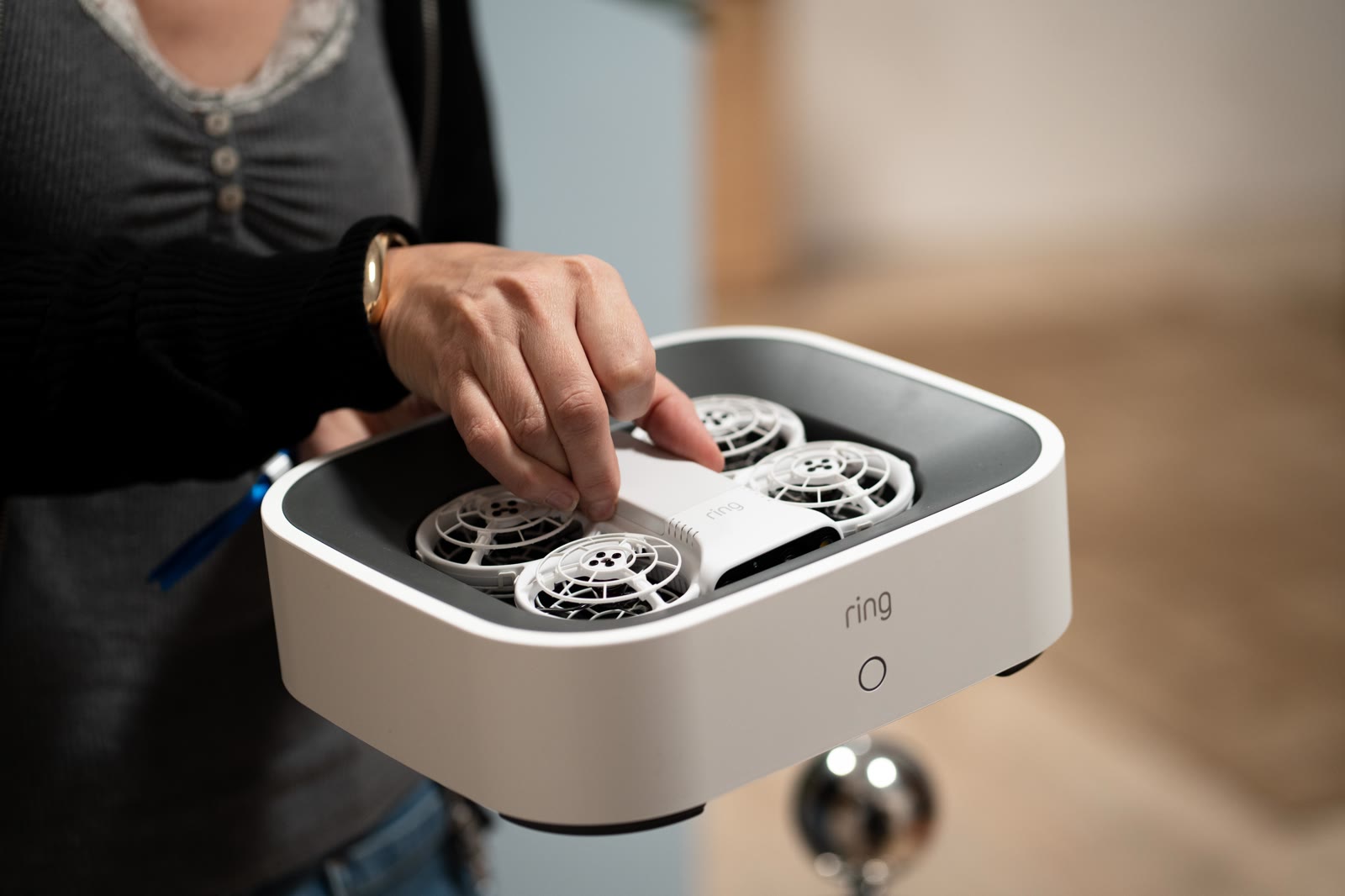
The spec sheet gives eight minutes of flight on a new, charged battery, under controlled conditions. Tests by the US press bring the range down to five to eight minutes depending on the height of the route, and recharging takes about eight minutes per minute of flight, or almost an hour to set off again fully charged.
The dependence on the network is accepted: the drone carries no sensors beyond those needed for landing, and most of the computing is done on Amazon's side. Disconnected from Wi-Fi, it can take off and land, not much more. Routes, obstacle recognition and responses to alerts go through the cloud.
What the manufacturer's documentation acknowledges
The product sheet itself lists the cases where navigation degrades: reflective surfaces such as polished marble or wet tiles, featureless matt walls, frameless glass and mirrors. A very smooth or very glassy flat is therefore the least favourable environment, which is ironic for an object sold as a high-end home assistant.
Three other caveats matter to an operator: the drone is specified for a single level, with multi-floor management presented as planned but not delivered; the propellers are deliberately noisy, with Ring embracing sound-based deterrence; and outdoor flight is blocked in software, because US regulation prohibits flight beyond the remote pilot's line of sight.
Jamie Siminoff, founder of Ring, said it plainly during the presentation: the device must not leave the house, because that is illegal in the United States.
Flight is also inseparable from a subscription. Scheduled patrols and video storage go through a Ring Protect plan, which Ring charges at $5 per month or $60 per year according to NBC News, while the public price list shows $4.99 per month or $49.99 per year for one camera (checked on 11 November 2026).
On privacy, Ring highlights three safeguards: the camera off and covered when the drone is on its base, LEDs on during recording, and end-to-end encryption of videos. The company has a troubled record on the subject, with a settlement reached with the US FTC in 2023 after employees accessed customers' videos, and a class action targeting the Familiar Faces facial recognition feature since December 2025.
Price and timetable: the United States first
The $249.99 corresponds to about €223 excluding tax at the exchange rate of 10 November 2026. Delivery is set for 27 January 2027, with a major caveat: Amazon states in its notes that the device has not received FCC authorisation and cannot be sold or rented before obtaining it. The date may therefore slip.
The Ring Rover Cam, a rolling robot for businesses at $999.99, is announced for 16 December 2026 and already available for pre-order. Both devices launch Ring Robotics, Amazon's new mobile security branch.
For Europe, nothing. Ring only talks about the US market, without any statement on a possible European version. History does not encourage optimism: the Always Home Cam, presented in 2020 at the same $250 price and sold in 2021 in a limited edition by invitation, never arrived on the Old Continent, and neither did Astro for Business. German reports on the announcement note the absence of any communication to that effect.
In Europe, a commercial void and a rather favourable legal framework
Such a device has no [[EASA](/glossaire#easa)](/glossaire#easa) class, because it is not marketed here, and its intended use places it outside the scope of flight rules in any case: at 165 g, it would remain below the 250 g threshold of class C0.
The European framework points in the same direction. The application material for Regulation (EU) 2019/947 (GM1 to Article 1, Decision ED 2019/021/R) states that the concept of unmanned aircraft operation does not cover indoor operations, defined as those carried out in a house, a building or more generally an enclosed space (tank, silo, cave, mine) where the risk of escape into external airspace is very low.
Regulation (EU) 2019/945, for its part, excludes from its scope, in Article 1(4), aircraft intended for exclusively indoor use.
In France, the DSAC's open category guide (edition 2, version 1.1 of 26 July 2026) deals with the case in paragraph 3.8: European regulation does not apply to flights in an “enclosed and covered space”, as basic Regulation 2018/1139 covers only the single European sky, which does not contain such spaces.
The safety of people present then falls to the owner of the premises and the remote pilot.
The guide recalls an exception that does not concern this drone: above 800 g, registration of the owner remains mandatory even in an enclosed space. At 165 g, the Ring Drone Cam is exempt, as it is exempt from the open category exam.
The switch is immediate, however, as soon as a device crosses a door or a window, with the operation then falling back into the open category with its distance and height rules. Marketing in Europe would also require CE marking and radio conformity, about which nothing has been announced.
The real European issue lies elsewhere, on the privacy side. The CNIL recalls that cameras installed in the home escape data protection rules only if they remain confined to the strictly private sphere, and that in all cases they must respect the privacy of visitors.
Two points of its doctrine directly affect this product: the prohibition on continuously filming employees working in the home, from cleaners to childminders and tradespeople carrying out work, and the rejection of concealed devices, with everyone having to be aware of the camera's presence.
A drone that sleeps in its dock and takes off on its own therefore raises a question of informing the people present at the moment it records, well beyond aviation law alone.
For professionals, autonomous indoor flight already exists, in another register. Caged drones such as the Flyability Elios 3, around 2.35 kg with a [LiDAR](/glossaire#lidar) and an onboard mapping engine, operate for about a dozen minutes in volumes where GPS does not reach. These machines serve the inspection of structures and industrial sites, at prices unrelated to a mass-market object.
What remains to be verified
FCC authorisation is a condition of release: without it, the 27 January date does not hold. The eight-minute battery life comes from the product sheet and from tests by the US press; no independent laboratory has published a measurement.
European availability, the price in euros and the exact cost of the required subscription have not been communicated. Multi-floor management is announced as planned without a deadline. Finally, navigation in real-world conditions remains to be judged, with the admission about reflective surfaces appearing in the manufacturer's documentation.
Information verified on: 11 November 2026.
← Back to home · Search · Suggest a topic · Lire en français / Read in French