
Drones & accessories — France
DJI Matrice 5T: 1K thermal, LiDAR and 59 minutes on a foldable chassis
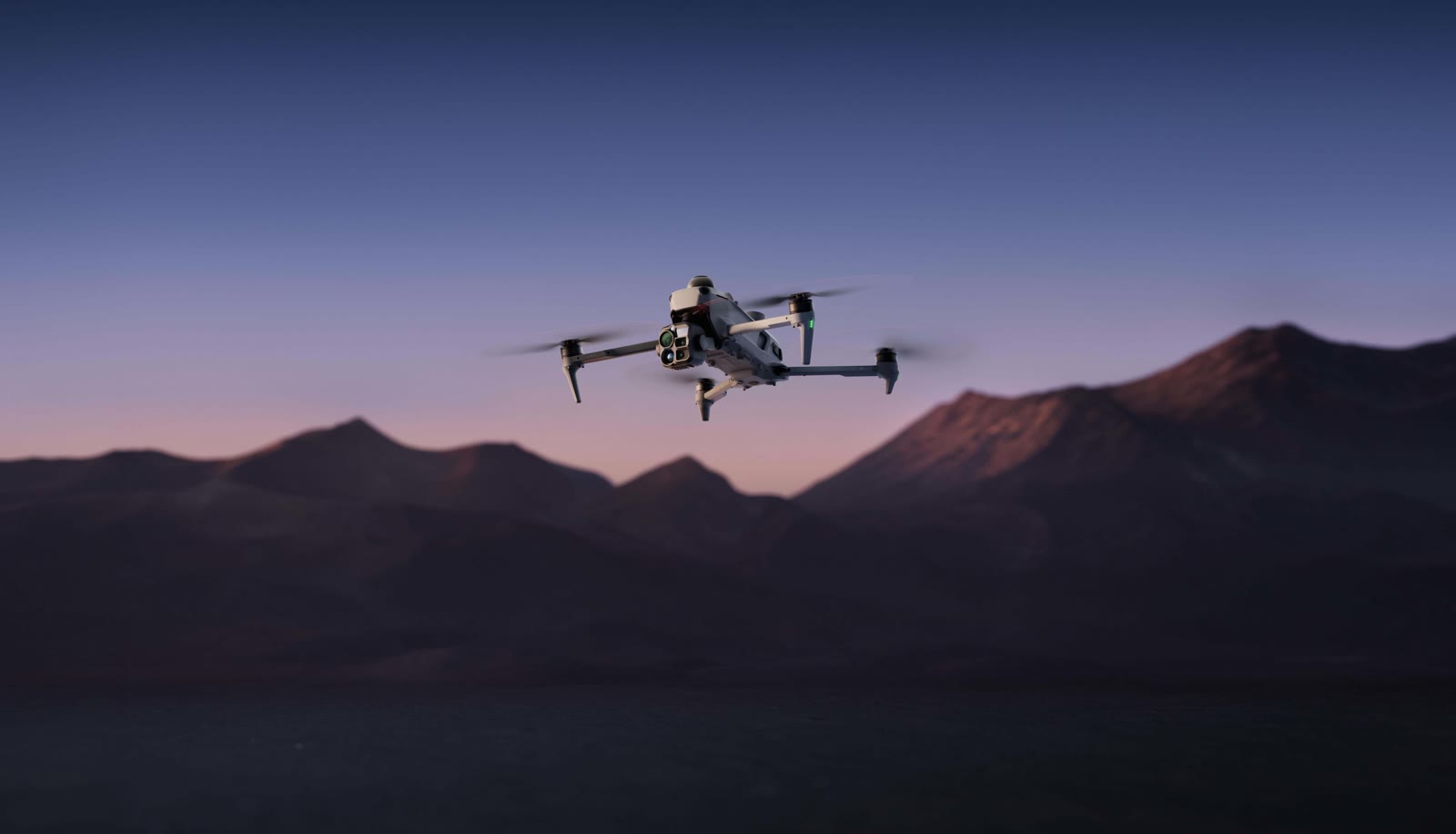
DJI presented the Matrice 5T on 5 November 2026, a radio-controlled version of the Matrice 5TD released on 14 October with the Dock 4. The global announcement came out of Shenzhen under the slogan "Always in Its Element", with no press conference and no public event in Europe: a press release, a product page and a series of video tutorials published the same day.
A folding airframe that carries the Matrice 5TD's payload
The Matrice 5T takes the 5TD's camera head into a fuselage with folding arms, designed to fit in a car boot and be airborne again in ten seconds. It weighs 2,239 g at take-off, with a maximum mass of 2,639 g and 400 g of payload across three E-Port ports.
Folded, it measures 335 × 155 × 203 mm.
Endurance improves markedly over the Matrice 4T: DJI claims 59 minutes in horizontal flight at 9 m/s and 54 minutes hovering, with a 215.2 Wh 6S Li-ion battery (768 g, 200 cycles).
Speed rises to 23 m/s, wind resistance to 12 m/s and the operating ceiling to 7,000 m. IP55 protection and a temperature range of -20 to 50 °C clearly target operations in rain and on industrial sites, where the Matrice 4T stopped at -10 °C and claimed no weather sealing.
The camera head lines up four channels. The wide-angle unit carries a 50 MP 1/0.98-inch sensor at f/1.8 (23.5 mm equivalent), with sensitivity claimed up to ISO 1,638,400 in night mode: DJI speaks of a colour image at 0.01 lux.
The medium telephoto (1/1.28 inch, 50 MP, 70 mm, f/2.88) is for close-range detail on lines and bridges, the telephoto (1/1.5 inch, 50 MP, 252 mm) reaches 11x optical and 176x hybrid, with monochrome night vision and licence-plate reading claimed at 400 m.
The thermal imager is an uncooled VOx microbolometer of 1,280 × 1,024, 8 µm pitch, f/0.85 lens and NETD ≤ 50 mK, which switches to 2,560 × 2,048 when UHR mode is enabled.
A class 1 laser rangefinder reaches 3,000 m, and an auxiliary infrared lamp completes the night set-up.
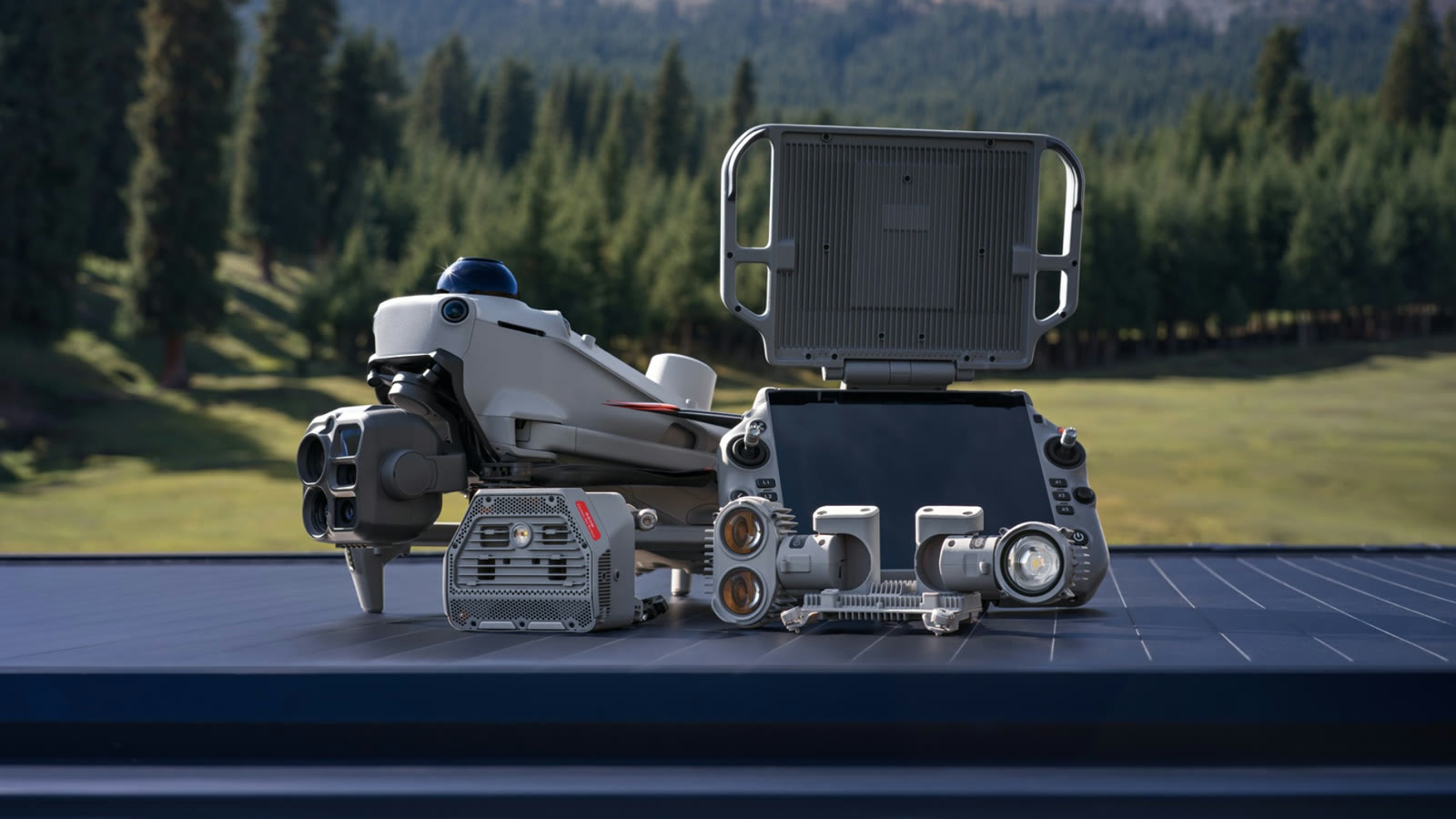
On the equipment side, DJI supplies a new RC Plus 3 Enterprise controller (7.44-inch screen, 2,000 nits, IP54, Android 16), an AS2 speaker rated 120 dB at 1 m with a 400 m range, a 60 W AL2 spotlight, and a 515 W charging hub that fills three batteries in sequence.
The first year of DJI Care Enterprise Plus is included.
Perception: LiDAR, radar and vision combined on a 2.2 kg aircraft
This is the most tangible change for a remote pilot. The Matrice 5T is the first compact DJI drone to carry a rotating LiDAR, a millimetre-wave radar and omnidirectional colour vision as standard.
The LiDAR scans 360° at 250,000 to 460,000 points per second, detects a thin obstacle at 110 m and a power line at 32 m at night. The radar covers the front (40 m on a 10 mm insulated cable), the top and the bottom (20 m), and keeps returning distances in fog, rain or dust.
Six colour fisheye sensors provide visual positioning down to 0.5 lux, with radar and visual data fused when GNSS fails, in a canyon or between two buildings.
| Feature | Matrice 5T | Matrice 4T |
|---|---|---|
| Take-off mass | 2,239 g | 1,219 g |
| Endurance | 59 min (54 min hovering) | 49 min |
| Native thermal | 1,280 × 1,024, 8 µm pitch | 640 × 512, 12 µm pitch |
| Hybrid zoom | 176x | 112x |
| Laser rangefinder | 3,000 m | 1,800 m |
| Obstacle detection | LiDAR + radar + colour vision | Vision only |
| Protection | IP55, -20 to 50 °C | None, -10 to 40 °C |
| Link range (CE) | 20 km | approx. 12 km |
The rest of the chain follows. The O4 Enterprise Enhanced link claims 20 km in CE and 40 km in IC, with two Cellular Dongle 2 modules (one eSIM and one nano-SIM) and relay topologies in which a second drone serves as an aerial station.
The onboard AI recognises more than twenty target types by analysing thermal and visible imagery in parallel, accepts text or image prompts from FlightHub 2, and allows third-party models to be loaded onto the onboard computer.
With DJI Terra, photogrammetry is claimed to centimetre accuracy without ground control points, and 200 photos are turned into a point cloud or a 2.5D model in eight minutes directly on the controller.
Two technical caveats deserve to be raised straight away. The shutter remains electronic, with software rolling-shutter correction: the Matrice 4E and its mechanical shutter retain the edge for demanding mapping.
And all the figures above come from DJI, measured in a controlled environment, with no independent test bench published to date.
European framework: what the weight and class change
At 2,239 g, the Matrice 5T falls outside class C1, capped at 900 g. It therefore cannot fly in A1, and its operation in Europe depends on a C2 marking (under 4 kg, with the A2 exam and a 30 m distance from third parties, reducible to 5 m in low-speed mode) or, failing that, on flying in A3 far from built-up areas.
As of 5 November 2026, EASA's "Drones for EU Operations" list contains no Matrice 5T entry: only the Matrice 5TD appears there, in C5 (STS 01) and C6 (STS 02). In its press release, DJI mentions the Flight Termination System module as a technical prerequisite for C6, without publishing an EU declaration of conformity for the 5T.
The aircraft's actual class therefore remains to be confirmed on the EASA list and in the declaration of conformity before any purchase for an A2 operation or an STS scenario.
The price is not public in Europe. DJI has only given a price for mainland China, CNY 57,488, and British dealers list "price on request". In Australia, a demonstrator listing spotted before the announcement by dronenr showed AUD 10,370 excluding DJI Care, compared with AUD 10,158.50 for the Matrice 4T with Care at the same distributor: the comparison is not like for like.
One logistical point matters for travelling teams: the 215.2 Wh battery exceeds the IATA 100 Wh threshold. It can still be carried in the cabin with the airline's agreement, up to two spare batteries, but it rules out standard checked baggage and changes the calculation for missions abroad.
International press praises the sensor, awaits the tests
Italian agency ANSA covered the announcement the same day, stressing emergency response, infrastructure inspection and the first joint integration of LiDAR, millimetre-wave radar and omnidirectional vision.
Also in Italy, Quadricottero had already picked apart the camera block's evolution versus the Matrice 4T on 30 October: telephoto from 168 to 252 mm, zoom from 112x to 176x, thermal from 640 × 512 to 1,280 × 1,024, at the cost of a minimum focus distance that has gone from 3 to 5 m.
In the United Kingdom, dealers published within the hour.heliguy highlights cable detection, IP55 and the 59 minutes, and publishes a 5T versus 5TD comparison that recalls that the latter remains a dock drone, flyable only in backup mode.
Coptrz targets police, fire services and drone search teams, using the 400 m plate reading as its argument, and publishes its own head-to-head with the Matrice 4T.
In Japan, system5.jp published a 5T versus 4-series comparison table that evening, and Sekido announced distribution from 5 November with a webinar co-organised with DJI the following day.
In China, IT之家 gives the official price and two details absent from the Western press release: noise claimed at 80 dB(A) thanks to swept-tip blades, and 98% more thrust per axis than the Matrice 4T.
In the United States, DroneXL has been following the story since the July leaks and focused mainly on the native 1,280 sensor, publishing the debate on American imagers' lag behind this format.
DroneDJ, for its part, covered Dock 4 and the Matrice 5TD but had not yet devoted an article to the 5T by midday. Nothing has been announced for the US market, where the 5 series remains absent.
In France, no pickup was identified in the specialist press on the day of the announcement, which leaves the field open for in-depth coverage of the regulatory angle.
← Back to home · Search · Suggest a topic · Lire en français / Read in French