
Professional applications — United States
Zipline: three partners each want one million deliveries per day
Three partners, a demand that exceeds the company's plan
Keller Rinaudo Cliffton described, in a 19-minute interview with Molly O'Shea for the Sourcery podcast published on 22 November, three or more partners that each want to buy more than one million drone deliveries per day.
The recording took place at the TomorrowX summit in Austin, on the morning Zipline announced the launch of Uber Eats in Spring, Texas. The company's operating plan targeted one million per day in about two years.
It was abandoned and rewritten for growth three to five times faster over two years.
Two partners are named. Uber Eats aims for one million deliveries per day by the end of 2029, about a quarter of the platform's US deliveries, under a contract supposed to cover almost every metropolitan area in the United States.
The pace to sustain represents about 233 times Zipline's current rate, around 4,300 deliveries per day worldwide according to The Verge, cited in the coverage of the 2029 target.
The third partner is not named.
Walmart comes next. The estate goes from 22 supercentres to 300 in a first phase, with what follows depending on the performance of that phase. Customers can order around 90,000 of a supercentre's 100,000 product lines.
The 5 November note on the Walmart agreement did not include either the figure of 22 or the performance condition, and announced 300 additional sites with a possibility of expansion. Two versions therefore coexist, that of the press release and that of the executive.
What the spec sheet gives, and what it does not
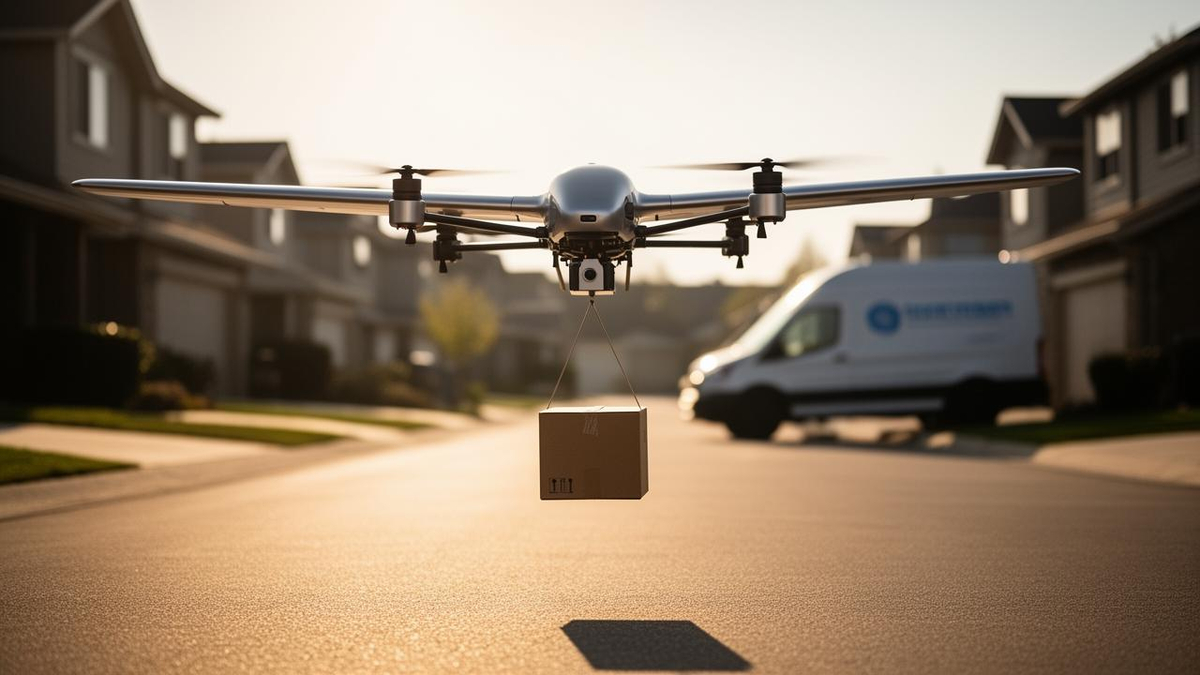
The aircraft concerned is Platform 2, which entered service in the United States in April 2025. Payload up to 8 pounds, range of 10 miles, package lowered on a stabilised cable from 300 to 400 feet, without landing.
Speed up to 70 mph, service from 8 am to 10 pm at launch in Spring, with no tip or surcharge for drone delivery. Zipline announces 2 to 5 minutes between the end of meal preparation and delivery, and around 25 charging sites in Dallas.
What the spec sheet does not give is longer. No aircraft price, no cost per delivery, no cost of setting up a charging site, no fleet size, no guaranteed throughput per site.
The only recent public volume is a cumulative total: more than one million deliveries in Dallas-Fort Worth since the start of 2026, or around 3,200 per day on average up to 5 November, according to the company's press release.
The figure given orally in the interview, more than one million per day in each active metropolitan area, contradicts the thread published the same day by the executive, who speaks of one million per year per metropolitan area.
The transcript records a probable slip of the tongue, not a verified figure.
An integration that does not require changing fleet

No migration from a previous generation of aircraft is described. The access condition remains the same: hold an air carrier certification. Zipline obtained the FAA's Part 135 in 2022 and is one of the eight companies that hold it, according to its investor Salesforce Ventures, which came on board at Series I.
BVLOS approval removes the one-pilot-per-aircraft constraint, which makes unit economics calculable.
The volume claimed by the same investor: 2.5 million commercial deliveries in eight countries, more than 150 million miles flown, with no serious incident. Zipline passed 2 million in January 2026, and more than 70% of its daily global volume was flying in the United States in summer 2026.
Walmart passed one million in May 2026, 40% of it in a single quarter, from 66 stores in four states, with an average of 23 minutes between order and drop-off. Wing, a Walmart partner, is under contract for more than 270 stores by 2027.
In Europe, none of these figures applies. The FAA is the US authority, its rules do not apply in European territory, and the continent's projects remain at demonstrator stage with no commercial service identified.
A European operator can read the US trajectory as an order of magnitude, not as a regulatory precedent.
Price, timetable and incidents: the boxes still empty
The $21.5 billion valuation and the $1.5 billion round led by Paradigm, WCM Investment Management and Layer Global, for a total raised of more than $3 billion, say nothing about the operating cost of a site or the price charged to the end customer.
These two figures are missing to assess the profitability of a site.
The authorisations give the measure of the timetable. The broadest approval signed by the FAA for Zipline, in December 2025 for Dallas-Fort Worth, covers 75 sites at 400 deliveries each, or 30,000 per day.
The Texas projects, 220,000 deliveries per day across Houston, San Antonio, Austin, Amarillo and El Paso, and the Arizona projects, 130,000 across Phoenix and Tucson, remain at draft stage, as does the application for 130,000 deliveries per day filed for Arizona.
A Seattle draft, 75 sites at 400 flights each, has been awaiting a decision since its consultation closed on 2 November 2025.
The federal framework is also dragging. Executive Order 14307 set a deadline of 1 February 2026 for the Part 108 rule, and the final text arrived for review at the White House on 10 July 2026.
The executive cites regulation and permits among the things slowing hardware production, without naming the FAA.
He names another, more prosaic risk: a supplier unable to keep up, “if a single supplier can't scale with you, then the entire thing is screwed”. US field reports remain rare, as with an Amazon MK30 that ended up on a garage roof, and no serious incident has been documented on the Zipline fleet to date.
← Back to home · Search · Suggest a topic · Lire en français / Read in French