
Professional applications — International
Uber Eats and Zipline deliver by drone in Spring, where Wing already flies
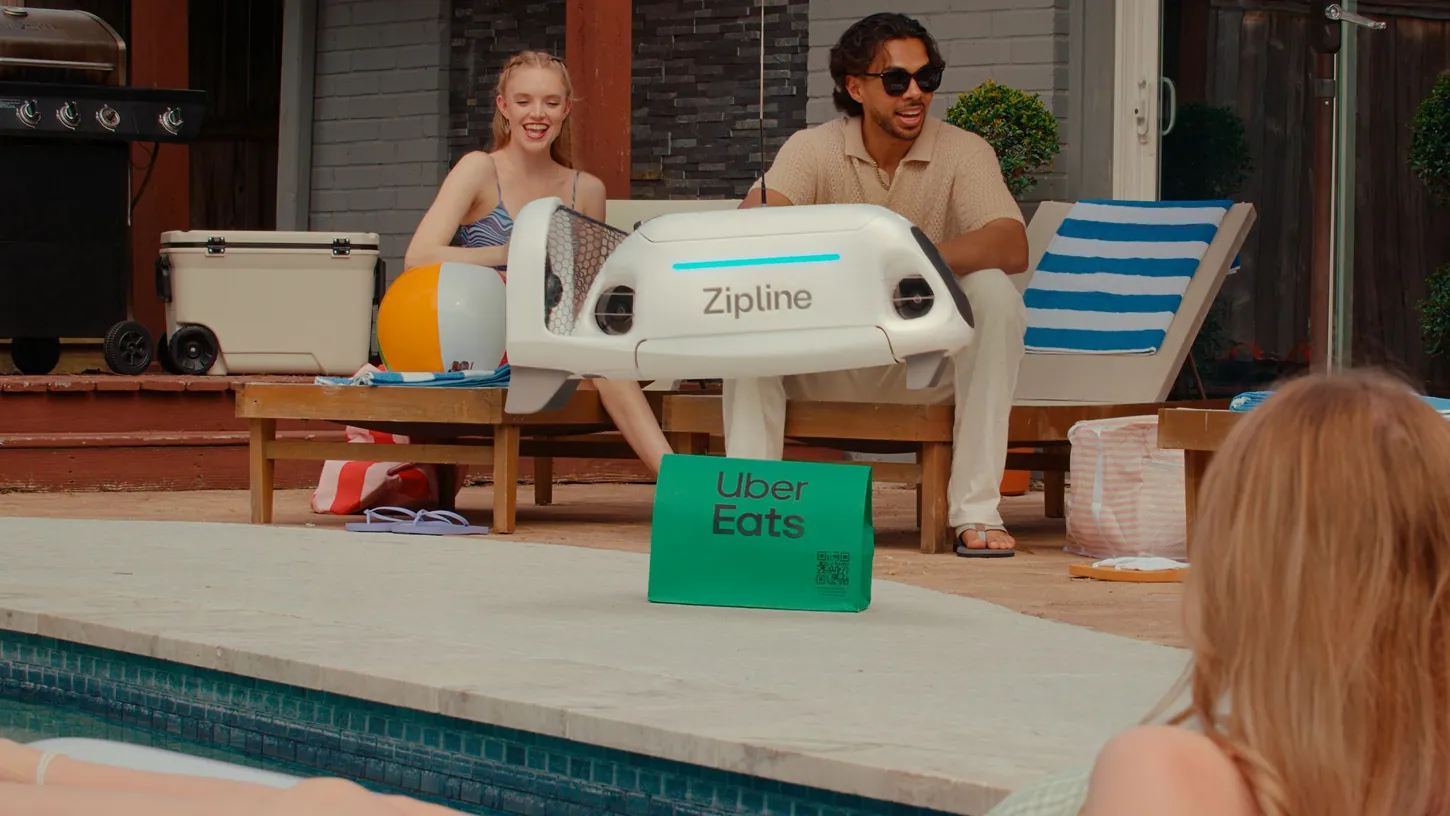
On 17 November at 8 a.m., the first Uber Eats flights in Spring, a suburb north of Houston, took off with orders capped at 8 pounds (3.6 kilos). The service runs until 10 p.m.
Spring, a suburb where Wing already flies for Walmart
Spring is not virgin territory for delivery drones. On 13 November, a resident of the Bridgestone neighbourhood told Chron that a dozen drones passed over her house every day and that the noise was driving her mad.
Chron attributed these flights to Amazon.
The public authorisations record places Wing, which delivers Walmart orders from two Spring Supercenters, within reach of her street. The operator is also preparing home delivery around Birmingham, while remaining at trials in Germany.
Zipline presents its own aircraft as the quiet ones. Dallas is the next announced stop.
A launch timed to a winch descent from 101 metres
The 17 November launch is the first under the agreement announced in August between Uber and Zipline. In the app, a Drone icon opens the list of participating restaurants, including Jersey Mike's, Zaxby's, Urban Bird and Abu Omar Halal.
Uber says a drone order costs no extra fee and does not display a tip prompt.
On the operator side, Zipline flies its aircraft from 330 feet (101 metres) and lowers the pod on a winch. This altitude matches the cruise altitude adopted in the FAA draft assessment of Zipline's Texas operations.
Wing stays at about 23 feet (7 metres) and Amazon lowers its MK30 to 13 feet (4 metres) before releasing the parcel. Zipline cites an average of 32 feet (10 metres) for drone delivery, without naming the operators that make up this calculation.
The company has held a Part 135 air carrier certificate since 2022, and closed a $1.5 billion funding round at a $21.5 billion valuation.
Noise figures from an internal model, an FAA file still in draft
Zipline announces a flight profile that reduces peak noise by 24% and shortens each flight by 53 seconds. These values, published on 27 October, come from internal modelling rather than ground microphones, according to the acoustic figures published by Zipline.
Take-off remains the noisiest phase, the reason cited before the Katy council the previous week for keeping the chargers on commercial land.
Neither the launch press release nor April's Houston announcement says where the chargers serving Spring are located. The FAA draft assessment for Texas, also a model, concludes there is no notable noise nuisance in its study areas.
The FAA environmental review page, consulted on 18 November, still lists the assessment for the five Texas metropolitan areas as a working document. It covers Houston with up to 65 charging sites and 65,000 deliveries per day.
The public comment period is closed.
What another network can reuse, and what remains Texan
Two operators over the same suburb require separating corridors and altitudes. The gap between Zipline's 101 metres and Wing's 7 metres leaves a margin that another network can reuse.
The charger installed on commercial land avoids adding noise at the property boundary.
Winch delivery eliminates landing at the customer's premises, which Amazon's MK30 does not do. What does not transfer is down to the American framework: Zipline's Part 135, the draft status of the Texas file, acoustics calculated on a model.
The Part 108 rule, intended to make beyond-visual-line-of-sight flight routine, has been under review at the White House since 10 July, i.e. 131 days as of Wednesday 18 November, and the FAA's draft Part 146 concerns drone traffic without controllers.
In August, Zipline put its global rate at one delivery every 20 seconds, around 4,320 per day, nearly one 230th of its 2029 target. In Spring, the open question remains the Houston FAA file, still in draft.
No final publication date appears on the page consulted on 18 November.
← Back to home · Search · Suggest a topic · Lire en français / Read in French