
Professional applications — DE
Wing prepares home delivery around Birmingham, Germany remains in trials
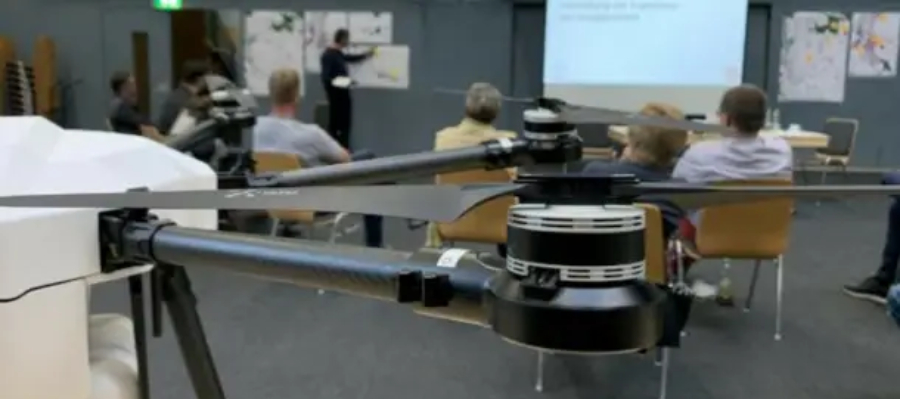
In Wusterhausen/Dosse, in the Ostprignitz-Ruppin district, the Marktschwalbe lifts crates of at most three kilos to three hamlets twelve kilometres away. The test funded by the Bund starts from the weekly market and drops the goods at fixed points, where customers come to collect them.
The scheme dates from 2024. Two years later, food delivery by drone in Germany has not moved beyond this stage: supervised trials, not a service.
Wing announces deliveries to British doorsteps
Wing is preparing for the first time drone deliveries to British households, opening a competitive front with Amazon's Prime Air. The target announced on 16 November 2026 covers several towns around Birmingham, where the Google subsidiary is to test food delivery to doorsteps.
The announcement mentions no German site or commissioning date in Germany.
A home delivery test in the United Kingdom does not constitute authorisation to fly over Germany. No German deployment timetable or list of open zones accompanies the project. What is circulating remains a commercial projection, without any regulatory decision.
Three kilos, twelve kilometres and a fixed collection point
The Wusterhausen project shows what a food drone can really handle. The crate is capped at three kilos, flights are cancelled in strong wind and storms, and the aircraft still take off in light wind and rain.
At least a dozen households receive free deliveries, provided they travel to the landing point. In the same slot, Flugplatz Welzow was due to send paper mail with delivery vehicles equipped with a 5G link, in the presence of the Land economics minister, Jörg Steinbach.
The United States provides an order of magnitude for the framework that makes these flights possible. The first set of rules unveiled in June, which entered into force on 29 August, allows aircraft of less than 55 pounds, or 25 kilograms, to fly in sparsely populated areas, up to 400 feet, or 120 metres, and during the day.
The FAA administrator Michael Huerta said that 500,000 recreational drones had been registered in eight months and that commercial operators needed additional rules.
From demonstration flight to hub network
The change of scale is already under way at Wing. On 11 January 2026, at the National Retail Federation, Google CEO Sundar Pichai presented the expansion of Wing's business as part of the deployment of artificial intelligence platforms for retailer growth.
The partnership formed with Walmart in 2025 is to be extended to 150 sites during the year. By 2027, the company plans a network of more than 270 drone delivery hubs, from Los Angeles to Miami.
The previous approach, that of demonstrations, rested on a single flight and a showcase. A hub network requires land sites, take-off slots and vehicle-based replenishment logistics.
Amazon had made the promise as early as late 2013, with parcels delivered in under thirty minutes in some markets. The gap between that announcement and current capabilities is visible in the caps: Prime Air in England is limited to 100 deliveries per day.
In 2016, a US industry estimate put the benefits of drones to the US economy at more than 82 billion dollars and at some 100,000 new jobs by 2025.
What an operator can adopt, what remains local
Three design choices can be transposed. The three-kilo payload cap corresponds to top-up shopping and pharmacy items, not the standard parcel. The fixed collection point avoids hand-to-hand delivery and removes the question of dropping the parcel in front of an absent door.
Suspension of flights in strong wind and storms remains the rule, including for an aircraft presented as capable of flying in the rain.
Other elements do not follow. Nothing of the kind is announced for Germany: neither a timetable nor authorised zones. Retail and Deutsche Post are planning no regular drone delivery service in the country; the postal operator used a Paketkopter for tests with no announced operational follow-up.
The Odenwald precedent, with food deliveries combined with a cargo bike, belonged to the same family of experiments. The business model of hospital deliveries, however, has already been industrialised elsewhere: the distribution of Matternet drones in 3,000 hospitals shows that a closed loop between two fixed sites is deployed faster than a route serving private households.
Logistics operators are waiting for a date and a list of municipalities where a drone can drop a parcel in Germany. Neither has been announced. The technical threshold is known: the crate weighs three kilos, the useful distance is around twelve kilometres.
The German regulatory threshold, however, has not been crossed.
← Back to home · Search · Suggest a topic · Lire en français / Read in French