
Business — CA
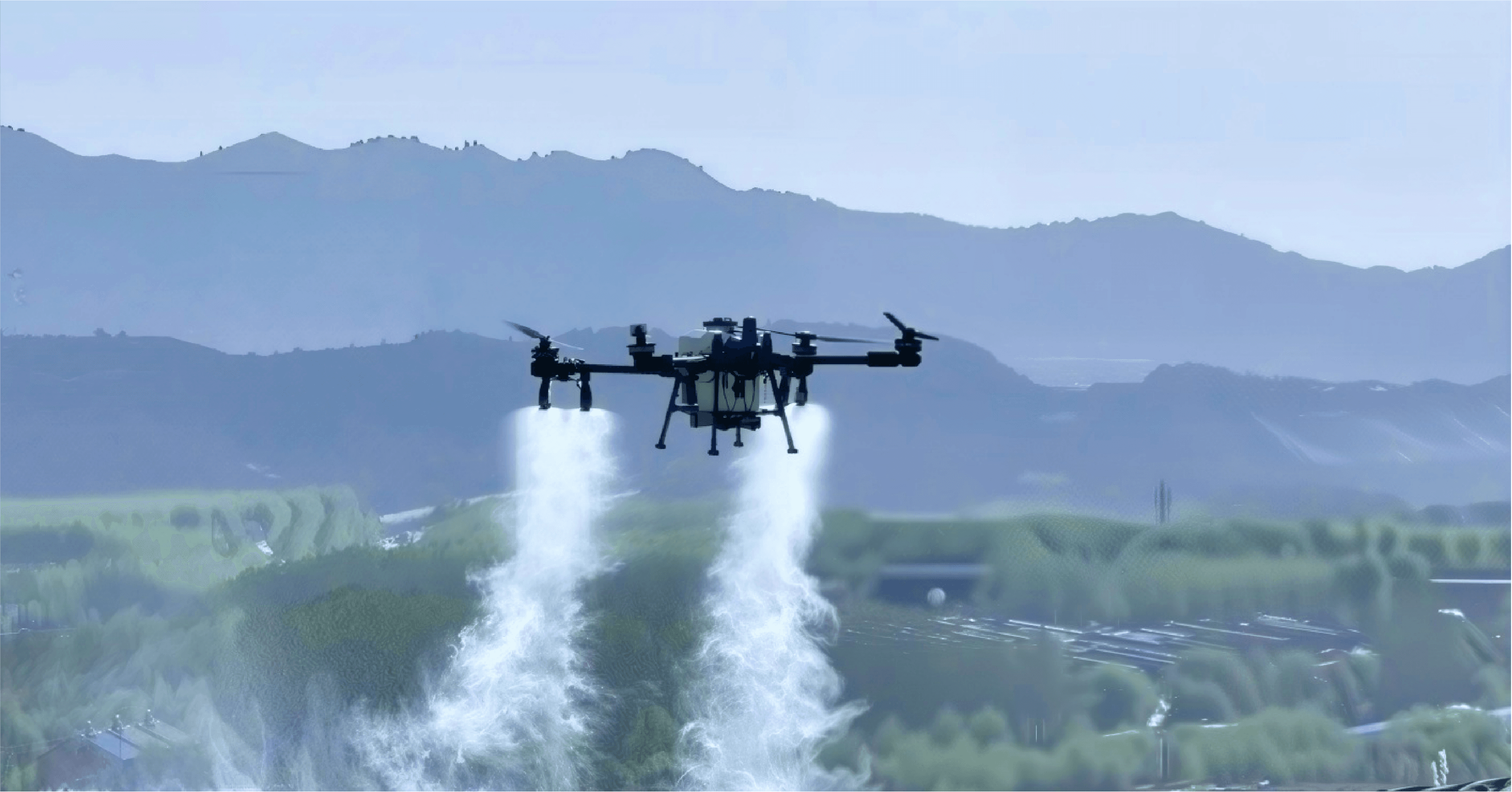
A spraying drone compared to a million-dollar machine in Canada
The sprayer price as a point of comparison
A CTV News report published in Toronto on Sunday 22 November 2026 places side by side a spraying drone and an agricultural sprayer whose price reaches one million dollars. The amount sets the capital a contractor ties up before treating the first hectare.
The comparison concerns the drone's contribution relative to that sum.
For a spraying business, one million dollars only pays for itself on large areas treated quickly, in windows when the ground can support the machine. The drone is judged on the slots that this machine cannot take: waterlogged field, isolated block to re-treat.
Throughput is counted in cycles, not flight speed
EAVision recalls in its comparison between drone spraying and ground spraying that a drone's productivity depends on the complete cycle: filling, take-off, spraying, landing, battery swap, recharging, cleaning and moving between fields.
An advertised flight speed says nothing about the number of hectares completed by a team.
The J150 from the same brand has a 70 L tank, a maximum flow rate of 40 L/min and an effective spraying width of up to 15 m. At full flow rate, the tank empties in less than two minutes of flight.
The onboard volume remains the limiting factor, as in the cotton defoliation trials in Auburn, conducted at 3 gallons per acre.
The University of Minnesota Extension, cited by EAVision, reports drone trials with results close to those of ground sprayers using about one tenth of the spray mixture volume. This result is not an exemption: low-volume spraying requires label approval and field verification.
For a contractor, the question becomes the volume treated. The 15,000 hectares of cover crops sown by Oligoplus in 2026 give an order of magnitude of what a fleet organised in short cycles can get through.
Weight decides the regulatory framework
The Canadian report does not say under what regulatory conditions the drone would fly. Elsewhere, the weight of the aircraft settles the question: in the United States, a drone over 55 pounds, around 25 kg, must obtain an exemption under Section 44807.
In Europe, the Warsaw regulatory opening concerns agricultural drones with no announced application date.
What the comparison leaves out of the calculation
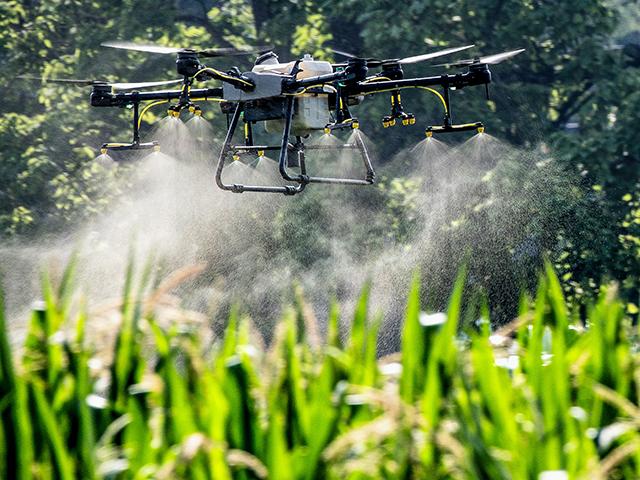
Weather remains decisive. Temperatures between 60 and 85 °F (15 to 29 °C) are favourable for most plant protection product applications, and wind reduces flight windows.
EAVision notes that the drone is more exposed to this than a ground sprayer, whose boom works lower.
Coverage quality is not a given. Flow rate, height, droplet size and effective width settings interact, and a crosswind shifts the effective width.
DTN reports that the downwash from the rotors pushes products deeper into the crop canopy, in its piece on the return on investment of spraying drones. Taylor Moreland, founder of Agri Spray Drones in Missouri, says there that most farmers will have their own drone in five to ten years, and that a fully autonomous operation, with no presence in the field, should follow within five years.
The Canadian comparison does not specify what the drone cannot cover. Low-volume applications remain subject to label approval and field verification.
← Back to home · Search · Suggest a topic · Lire en français / Read in French