
Business — CH
A Swiss drone executive urges the Confederation to invest in AI
A call to invest in AI, with no amount announced
Nathanel Apter, a member of the board of Drone Industry Association Switzerland (DIAS), is calling on the Confederation to commit public resources to artificial intelligence. The sector's argument comes down to one sentence: without public funding for AI research, drone solutions designed in Switzerland will lose technical autonomy and competitiveness against foreign manufacturers.
Apter bases his case on a finding already published in the 2024 Swiss sector report: the country has a strong research ecosystem in robotics and artificial intelligence, backed by ETHZ, EPFL and ZHAW.
The rest of the reasoning concerns regulation. The European framework applies in Switzerland and opens access to the EU market, which remains an advantage for a manufacturer established in Lausanne or Zurich. This framework is however recent, and Apter considers that it is not yet mature enough for some companies to derive revenue from it.
He draws an operational conclusion from this: the sector must formulate proposals for improvement, and regulators must calibrate a framework that meets its needs. No measure, no budget appropriation and no timetable have been announced at this stage.
A sector worth CHF 569 million, CHF 871 million in 2030
The figures in the 2024 report show the scale of the issue. The Swiss drone industry generated CHF 569 million in revenue in 2024, an amount the sector projects to reach CHF 871 million in 2030.
Some 6,500 people currently work in this sector.
Switzerland ranks eighth in the world for funding raised by drone companies, and first for market size per capita. These volumes remain modest at continental scale, where traffic ambitions are of another order, as shown by the target of five million drone flights per day targeted in Europe by 2030.
The per-capita ranking partly explains Apter's argument. A narrow domestic market forces Swiss companies to export their technology, and therefore to fund R&D that the Confederation does not subsidise at the same level as its neighbours.
The report identifies four strengths highlighted by companies in the country: the availability of talent, the Swiss-made label, the quality of the ecosystem and quality of life.
None of these four points offsets a shortfall in public funding for AI, according to the thesis advanced by the association official. The debate echoes the one running across Europe about the sector's dependence on public aid, the subject of European industry judged dependent on subsidies.
SenseFly, 130 employees and 100 to 200 drones per month
The ecosystem Apter refers to has an address. SenseFly, founded in 2009, is headquartered in Cheseaux-sur-Lausanne, about ten kilometres north of the city. The company employs more than 130 people and produces between 100 and 200 drones per month, intended primarily for surveyors, farmers and quarry operators.
It generates most of its revenue internationally, which makes it directly exposed to comparison with foreign competitors.
The country has more than 70 companies active in the drone market, according to a count cited by Le Temps, including around twenty in the canton of Vaud. On the consumer side, more than 100,000 machines, each worth several hundred Swiss francs, are in circulation in the country.
This industrial density shifts the AI funding question towards production costs. A company producing 100 to 200 devices per month for measurement and spraying uses depends on the quality of its image processing and flight software.
A delay on these building blocks directly affects unit costs and export tenders.
Defence and security, the context driving demand
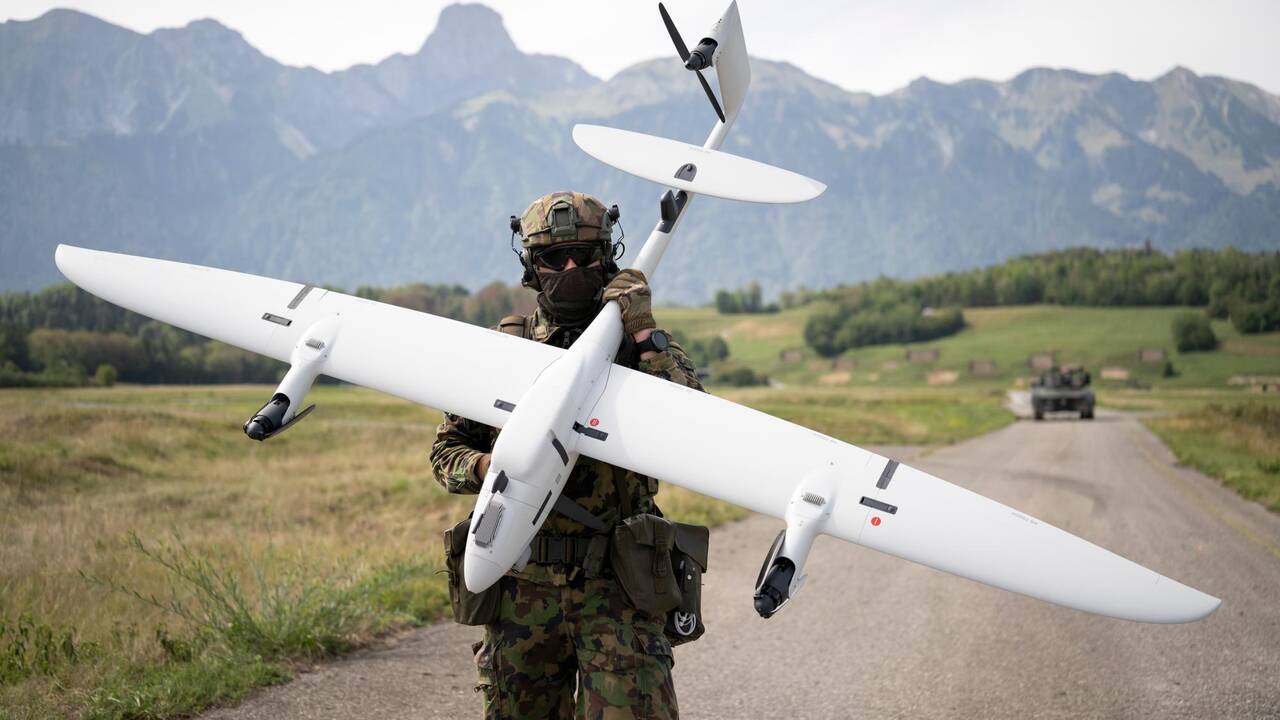
The debate on resources is compounded by a security context that the Confederation itself has put on the table. On 19 October 2026, the Taskforce Drones brought together industry, research, the armed forces, administration and politics for the first time in Thun, at the army training area, during the Swiss Drone Security Forum, as detailed by armasuisse.
More than 300 participants worked there on the country's future defence capabilities and on strengthening the Swiss drone ecosystem. The Taskforce Drones had been launched in 2024 by the national armaments director Urs Loher and several DDPS officials.
This military build-up intersects with another file, that of exports. In December 2025, Parliament adopted a relaxation of the law on the export and re-export of war material, a text subject to a referendum and a popular vote on 29 November 2026 in Switzerland.
Several young Swiss companies active in defence drones have moved their headquarters abroad because of the export rules in force. On this point as on AI, the sector is waiting for public decisions. No funding envelope has been quantified for artificial intelligence.
← Back to home · Search · Suggest a topic · Lire en français / Read in French