
Reviews — International
Chinese drone sows pre-germinated rice in rows and gains 11%
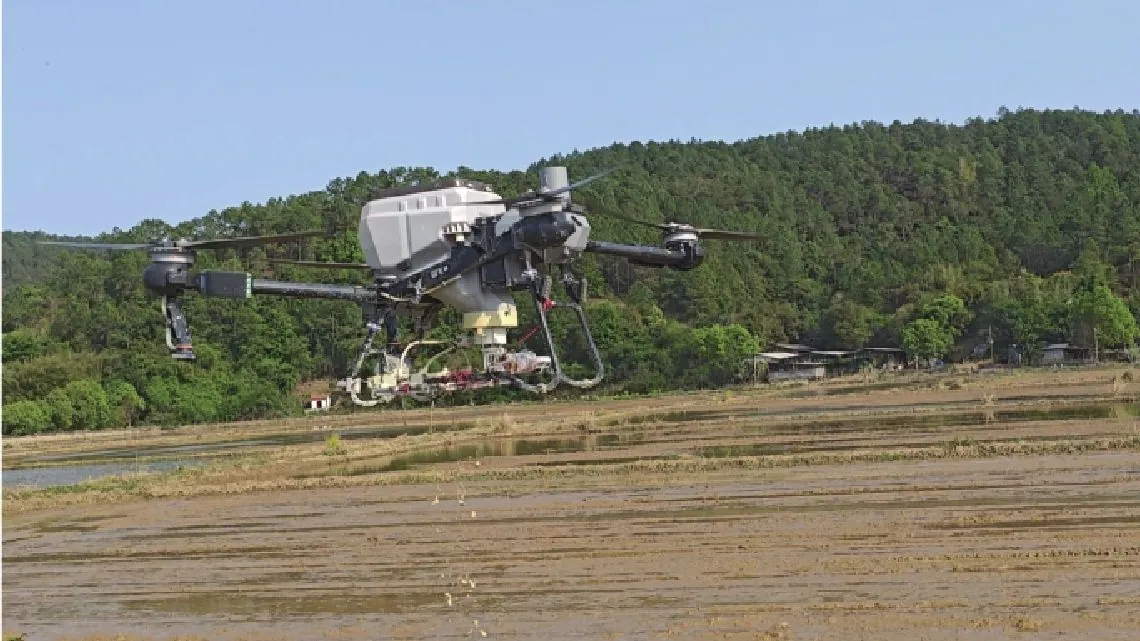
Yield and placement measured in the Zengcheng trial
A prototype from South China Agricultural University in Guangzhou projects pre-germinated rice in rows instead of broadcasting it. At the November 2025 harvest, plots sown this way yielded 6,731 kg per hectare, against 6,040 kg for those sown by a conventional broadcast drone.
Sowing took place on 9 August 2025 at a test site in Zengcheng district, Guangzhou, with a flight at 2 m/s and 2 m above the mud.
The ranges bracket this result without overlapping: 6,430 to 7,028 kg per hectare for row sowing, 5,798 to 6,337 kg for broadcasting. Seed placement is the most robust measurement in the work.
Seed clusters landed with a standard deviation of 2.0 cm from the target line, against 2.9 cm with a commercial Seaflo DC pump mounted on the same machine.
The coefficient of variation of spacing between clusters reaches 13.2%, against 18.6% with this commercial pump. These values come from three sampling frames per pump, ten clusters each (placement measurement protocol).
The semi-open impeller pump selected for the mixture
Broadcasting lets the seed pass through the rotor wash, which deflects it off its line. The countermeasure chosen is speed: a pump pressurises the mixture and projects it in pulses at 10 Hz, fast enough that the rotor wash moves the seeds only slightly.
The mixture is soaked and germinated rice, with added cellulose powder, bentonite and water. Pumping this mixture is the difficulty: equipment designed for a liquid clogs, breaks seeds or loses pressure.
The team compared three architectures: axial pump, helical impeller pump and semi-open impeller pump. The latter scores 0.985 on the researchers' weighted index, against 0.464 and 0.231.
Simulations and bench tests then set four blades, a 76 mm impeller and a blade width of 22 mm. The pump delivers 1.12 kg of mixture per second and breaks 0.74% of the seeds, below the 0.8% ceiling set by the Chinese national standard for rice sowing by drone.
The commercial benchmark remains broadcasting, a method brought to rice by XAG in 2020 with a granular spreader. Rantizo is targeting agricultural broadcasting in California with Rantizo's California programme. The device comes from a team of six people, with Professor Zhou Zhiyan as corresponding author, and the design was published in the Transactions of the Chinese Society of Agricultural Engineering.
Three square metres per method to establish yield
The yield comparison is thinner than the placement comparison. The team harvested three 1 m² plots per sowing method on 22 November 2025, at a single site and in a single season (details of the harvested plots).
The yield findings therefore rest on a single trial, without independent replication, and large-scale reproducibility remains to be demonstrated.
Pre-germination adds a step before the flight: soaking, germinating, mixing with cellulose and bentonite. Seed breakage at 0.74% leaves a narrow margin below the 0.8% threshold of the Chinese standard, and the flow rate of 1.12 kg per second determines the forward speed needed to maintain the rows.
A contractor industrialising the process must therefore settle the preparation of the mixture before promising a work rate.
Quantified arguments for a drone sowing contractor
For an operator selling drone sowing, row sowing provides a quantified argument against broadcasting: 11% more yield in this trial and more regular placement.
The condition is operational, with mastery of pre-germination and pumping, which determine seed breakage and flow regularity.
Rice sowing by drone is already an established practice in southern China: in February 2020, DJI and a local agricultural cooperative sowed in Kaiping, Guangdong, during a field demonstration (the demonstration report).
Drone Industry Insights projects the civil drone market at USD 83 billion in 2035 (civil drone market forecasts). The 11% is not enough to price a service: it comes from one site, one season and three plots per method.
The figure most directly usable with a client remains the standard deviation of placement from the line, 2.0 cm against 2.9 cm for the commercial pump.
← Back to home · Search · Suggest a topic · Lire en français / Read in French