
Reviews — ES
Eurocontrol tests Galileo and EGNOS on drones in Ribeira Sacra
Galileo and EGNOS on board the same aircraft
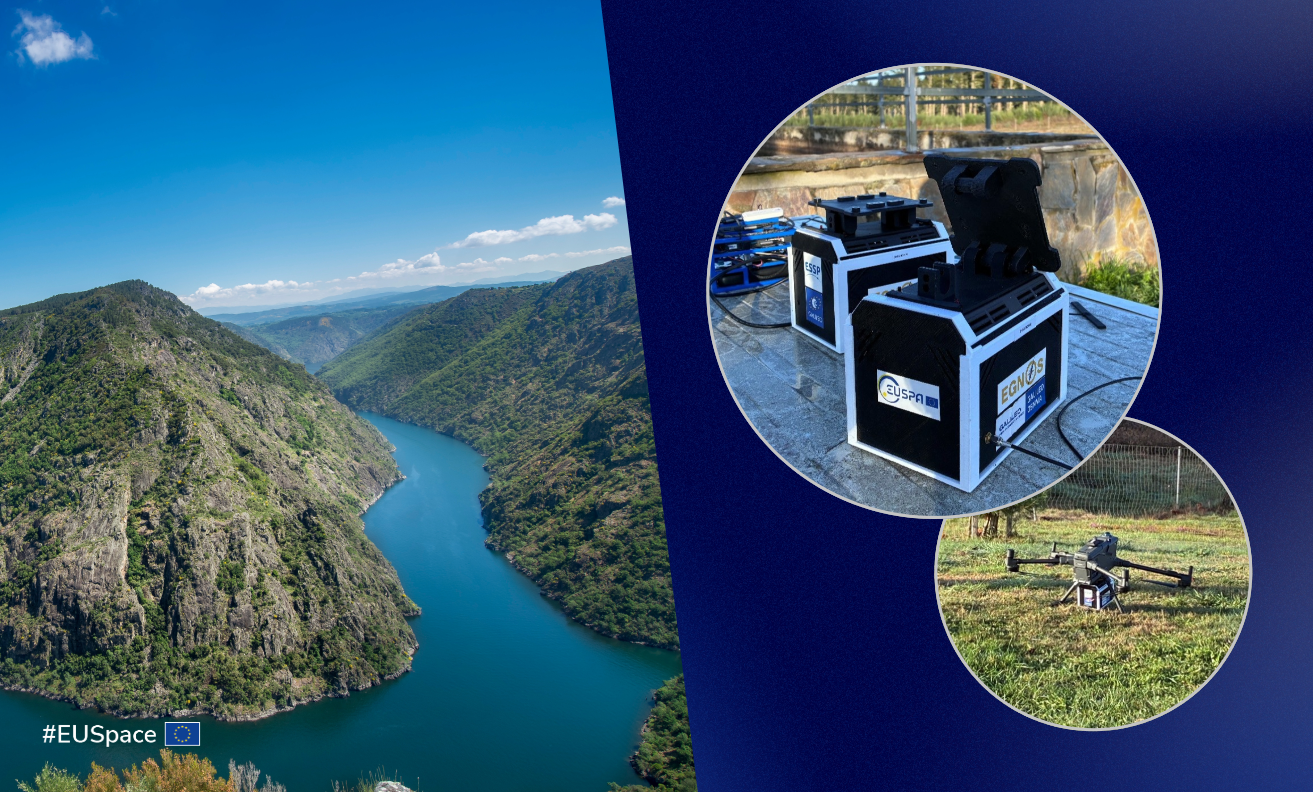
ESSP, the Toulouse-based operator of the EGNOS service, designed the GNSS units with EUSPA and its GNSS service centre. Two receivers were installed on board each drone.
The flights compare the positions calculated from Galileo, the European constellation of 30 satellites in orbit at 23,222 km, with those obtained via EGNOS, the satellite-based augmentation system that corrects GPS signals over Europe.
The comparison is made in flight, on the same aircraft and at the same instant, not on a test bench.
EGNOS relies on three geostationary satellites and a network of around forty ground reference stations. It broadcasts position corrections and an integrity signal, used by commercial aviation since 2011.
Galileo provides an open service and, since January 2023, a free high-precision service advertised at 20 cm horizontally. Bringing the two measurements together in a single receiver must establish whether a drone can combine the sources without losing the integrity of its position.
Two Galician sites with opposite constraints
The flights took place at two locations at the ESCAI centre, in Ribeira Sacra, in the province of Lugo. The Mirador de Triguás offers a rural environment in complex terrain, over the Sil canyons.
The Cadaval aerodrome, also used for firefighting operations, serves as the activity base.
AXPA Systems produced theoretical 4G coverage calculations on the ground and at 60 metres for both sites, to provide a planning reference for the electronic conspicuity trials. One terrain masks, the other opens up: both sets of measurements follow the same protocol.
Operators, authorities and suppliers on a single protocol
Eurocontrol is coordinating this series of campaigns with EUSPA and EASA, in several places in Europe, to gather data on GNSS and EGNOS performance and on electronic conspicuity.
The Spanish component brings together AESA, the air navigation provider ENAIRE, the operators INECO, Bluenest, Fuvex, Frontex, Aeromedia and Umiles, the Guardia Civil, Spanish customs, as well as ESSP and the GNSS service centre.
Fuvex, INECO and Bluenest handled the GNSS flights, while the Guardia Civil, Aeromedia, Umiles and Frontex conducted the conspicuity and surveillance tests.
The results are intended to feed the safe integration of UAS in the specific category in realistic scenarios, including BVLOS missions in open airspace and in constrained environments. This category requires a SORA analysis and a SAIL assurance level ranging from I to VI.
The framework remains the one under which the European Agency has already granted several SAIL III to cargo operators.
Precision, availability and cost remain to be quantified
No precision, availability or integration cost figures accompany the publication of the trials. The question applies to European manufacturers: a hardened Galileo and EGNOS receiver is only of interest for automatic flight if the solution lasts for the duration of a mission, including above a sensitive site, and if its price does not make the airframe more expensive.
On a drone of less than 25 kg, a dual-constellation receiver adds weight, power consumption and one more line of code in the navigation loop.
The precedent of the ECARO project, whose campaign ended at Grottaglie airport on 24 June 2021, shows that these experiments stretch over cycles of several years.
Ownership of EGNOS was transferred from ESA to the European Commission on 1 April 2009, and its operation has been delegated to EUSPA since 1 January 2014. The agency, based in Prague, has since the 2021 regulation combined the competences of the former GSA and the management of the Galileo and EGNOS programmes.
The next milestones are known: the User Consultation Platform 2026 takes place on 26 and 27 November, and the next EGNSS training for remote pilots is set for 23 April 2026 in Brno, Czech Republic.
The file of BVLOS dossiers submitted by manufacturers, such as that for the Dock 4 and Matrice 5TD, will depend directly on these figures.
← Back to home · Search · Suggest a topic · Lire en français / Read in French