
Regulation — IT
The Lucca court rejects compensation for a destroyed Autel Evo II
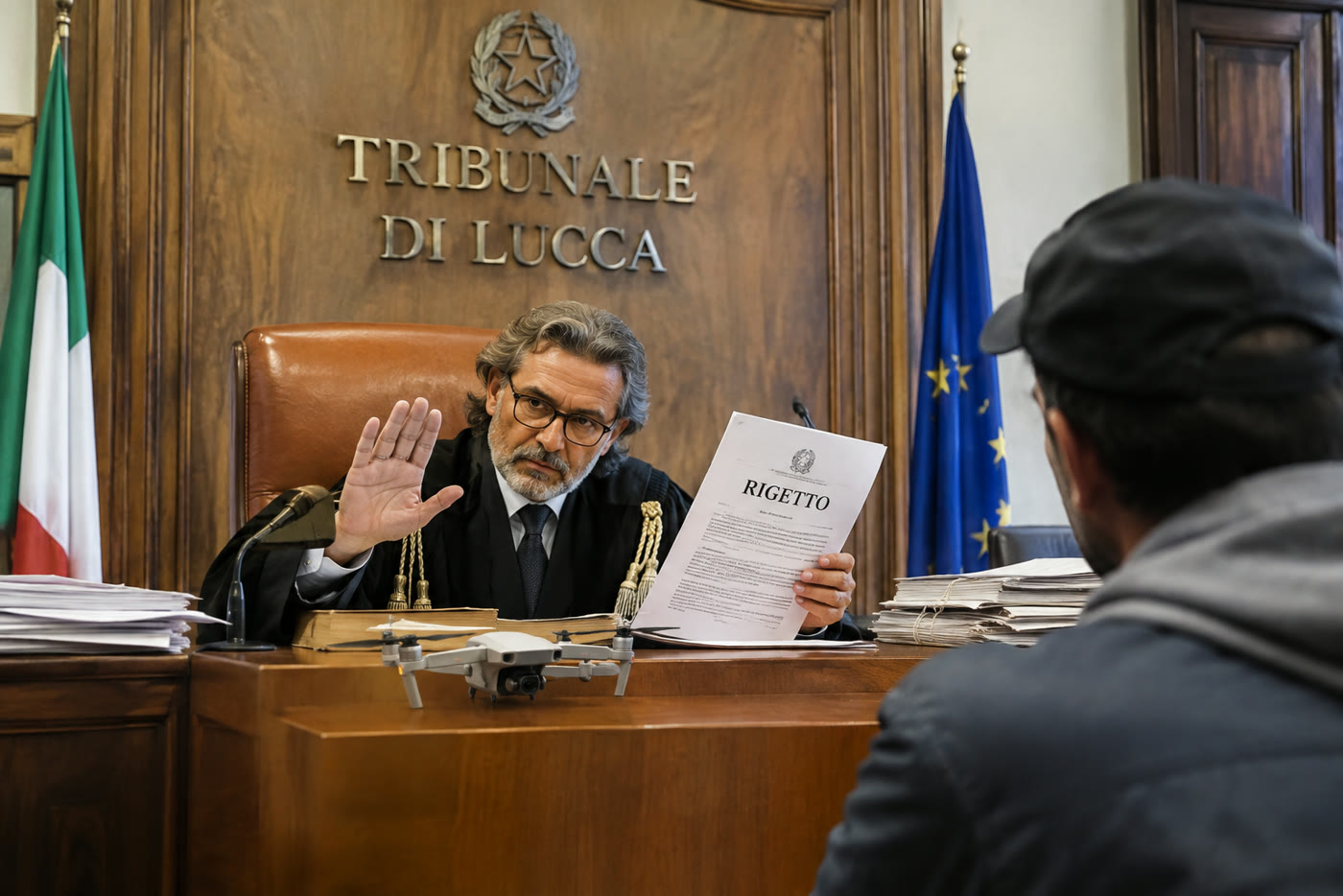
The Court of Lucca confirms the rejection of the claim for compensation
The Court of Lucca has published a judgment numbered 165/2026 in the dispute between a company owning a drone and its insurance company. The decision comes on appeal from a ruling of the justice of the peace of Lucca and confirms the rejection of the claim for compensation.
The aircraft, an Autel Robotics Evo II, was covered by a combined policy comprising civil liability and hull cover for the drone.
The company maintained that the aircraft had suffered an accident on 11 August 2022, with damage that could not be repaired. The claim was reported to the insurer, which did not pay. The company claimed €7,950, corresponding to the purchase price of the drone.
The justice of the peace rejected the claim, and the case then went up to the court, which handed down the decision published on 20 November 2026.
Proof of the claim does not stop at establishing the damage
The two levels of jurisdiction do not concern the reality of the damage, but its connection to the insured risk. The court relies on Article 2697 of the Italian Civil Code: it is for the party bringing the action to provide the elements establishing the merits of its claim.
Applied to the case, this principle means that the policy and the physical observation of the damaged aircraft are not enough. The insured must demonstrate the facts that concretely link the claim to the covered risk: how the accident occurred, where the aircraft was, what activity it was carrying out, who had control of it and whether the remote pilot held the qualifications required by the contract.
The court also sets aside the argument based on the claim declaration. That is an act drawn up unilaterally by the insured: it does not relieve the insured of the need to prove how the event unfolded, in the absence of corroborating elements.
In this case, precisely what was missing was proof of the factual circumstances and the place of the operation, the causes of the incident, and the identity and title of the remote pilot.
The questionnaire completed at the time of underwriting did not fill these gaps. The company had named a pilot-operator in it, but the document established neither that this person met the professional conditions laid down by the policy, nor that this person was actually at the controls on the day of the accident.
For an operator fielding several remote pilots and a fleet of UAS, traceability of the assignment of each flight therefore becomes an operational, safety and, from now on, insurance requirement.
The judgment does not rule on the evidential value of technical data, but its reasoning shows their interest: flight logs, telemetry, coordinates, controller data, recordings from the application used, photographs and videos of the site of the claim, the operator's communications, witness statements.
Relying solely on the insured's declaration after the event is the weakness that the court penalised.
This framework ties in with the European architecture: Regulation (EU) 2019/947 divides UAS operations between the open, specific and certified categories, with different operational and competence requirements for the remote pilot.
Operation category, qualifications, authorisations, conditions of operation and geographical zones may delimit the insured risk and its proof. Note that the decision concerns insurance for damage suffered by the drone, and not third-party liability insurance.
Report the claim and document its cause from the moment of the incident
For an operator, the consequence is practical. The file put together at the time of the incident carries more weight than the purchase invoice and the insurance contract. It must be possible to link the damaged aircraft to an identified flight, with the time, the place and the sequence of events, and then to submit a declaration consistent with those elements to the insurer.
A drone destroyed in poorly established conditions remains a destroyed drone whose reimbursement may be refused, as illustrated by the accident that occurred on a tower crane in Manchester. Insurance risk management therefore does not begin with the claim: it begins with the organisation and documentation of operations, flight by flight.
The Lucca decision says nothing about any criminal fault and does not constitute a conviction. It settles a contractual claim on appeal, and the published summary does not state whether it is final.
Nor does it remove the need to check flight authorisations, which fall under other litigation: in the United Kingdom, remote pilots have been prosecuted for flying in a restricted zone.
The company owning the Evo II did not obtain the €7,950 claimed.
← Back to home · Search · Suggest a topic · Lire en français / Read in French