
Business — EU
Stephen Sutton judges the European drone industry dependent on subsidies
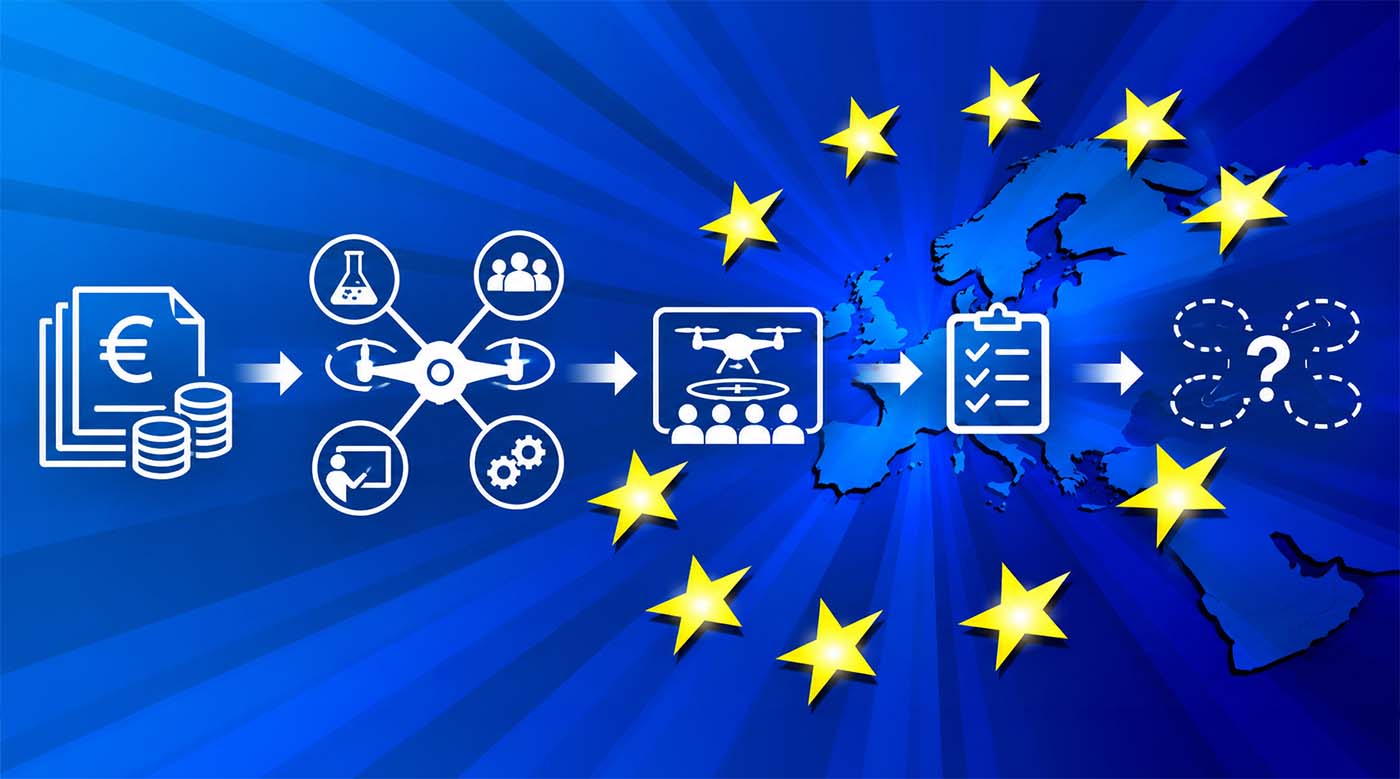
The amounts committed and the only market data available

European public money has funded years of drone research, innovation programmes and technology demonstrations, for a total running into millions of euros. Stephen Sutton, chief executive of FlyBy Guys, disputes the commercial effect of this spending.
The question raised is that of their conversion into invoiced services. The global drone market is estimated at USD 96.4 billion in 2026, up by nearly 15% year on year, and is expected to more than double by 2033 according to Grand View Research.
Direct aid paid to SMEs runs into tens of thousands of euros. One call offers non-equity grants of up to EUR 35,000 per SME for a six-month project, with an overall envelope of EUR 350,000.
MANTRA's second open call amounts to EUR 50,000 per company, with a deadline of 30 September 2026.
Accounts published by operators remain rare. Drone Volt reported EUR 3.6m in gross margin, up 41%, according to the details published by the operator.
A U-space rollout that stakeholders regard as blocked
Seven years after the European drone rules came into force and three years after the 2.0 strategy, large-scale use remains behind the ambitions. The results presented at the European Drone Summit in November 2026 measure this: 59% of stakeholders surveyed see no notable progress in the implementation of U-space, 34% see limited progress, and none considers it good.
The limited availability of services and uncertainty over costs and business models are among the obstacles cited. A new implementation roadmap is expected in 2027.
Sutton gives the example of a medical transport demonstration between two sites. It says nothing about day-to-day operations, the payer, aircraft maintenance or the provision of remote pilots.
His question concerns the post-subsidy period: a project that does not survive the end of public funding contributes little to the commercial sector, whatever the success of the original objectives (Stephen Sutton's argument).
The transition from demonstration to regular service remains the sticking point. The Commission is still looking for the commercial service behind the demonstrators it funds.
Demand materialising in Europe is primarily defensive. NATO countries have committed to 3.5% of GDP in direct defence spending and 1.5% in related infrastructure.
The EU-Ukraine Drone Alliance brings together European and Ukrainian manufacturers; it is among the deliverables of the Defence 2030 roadmap published in October 2025 and of the February 2026 action plan on drone and counter-drone security (the presentation of the alliance).
In 2024, 96% of the UAV used against Russia were Ukrainian-made.
Some European companies have commercial activity. On 22 September 2026, Beam Global signed a non-binding letter of intent to acquire a European company that already produces and sells drones and software to Fortune Global 500 clients.
The scope of the aid and the commercial share remain unclear
The share of commercial orders in the European sector's revenue is not quantified. The USD 96.4 billion covers a global market, across all applications, and no conversion into euros is provided.
No margin, no result and no year-on-year comparison are published for the sector as a whole.
The scope varies depending on the work. An analysis of Dutch industrial capacity uses the manufacture of transport equipment (C30), machinery for drone production (C28), R&D (M71, M72) and software (J62, J63) to cover the production ecosystem, based on Eurostat SBS 2023 data (the scope used by the study).
Eight European countries have an explicit drone production strategy, including the Netherlands with DroneBoost. France is investing in a value chain; Poland, Finland and Germany have plans.
The total of these national commitments is not known.
The organisations gathered within JEDA are asking that the evaluation of the 2.0 strategy be based on the number of flights, hours flown, entry-into-service times and the ability to operate across borders.
They note that the resources available remain limited in the face of international competition.
For an operator that lives on private contracts, the challenge is to document what its flights produce without subsidy. The target of five million daily flights in Europe in 2030 sets a framework; the share of these flights that will come from commercial orders has not been established.
← Back to home · Search · Suggest a topic · Lire en français / Read in French