
Professional applications — FR
Mirega develops a drone-embeddable greenhouse gas analyzer
A sensor that flies instead of sampling
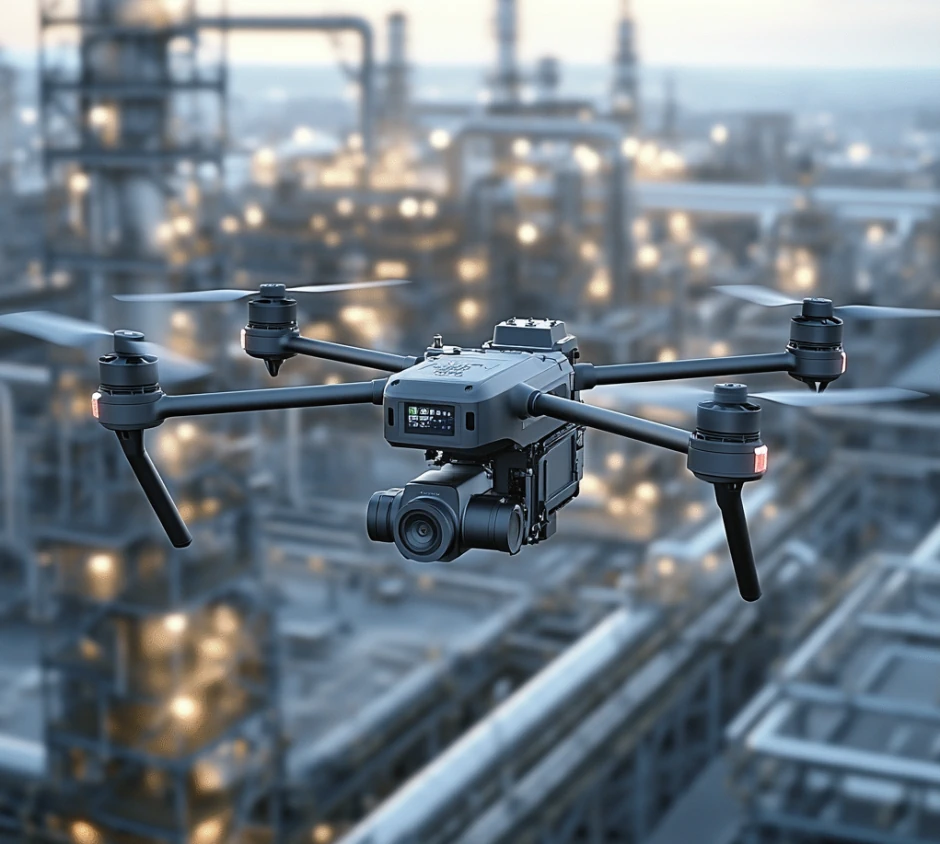
Mirega's sensor measures methane and carbon dioxide from a drone, without a ground station. The start-up, founded in 2023 and incubated at IMT Nord Europe, is developing a portable infrared analyser to detect leaks on pipelines and industrial sites.
Its founder, Vincent Hardy, is an optical engineer. He led ALPAO, an adaptive optics company, before launching Mirega.
The need is documented. In 2022, the rupture of the Nord Stream gas pipelines in the Baltic Sea released nearly 450,000 tonnes of methane, according to a study by the European Space Agency. On an operating pipeline, a tiny breach is enough to release several tonnes of gas per year.
Existing detection technologies remain rare, expensive or difficult to deploy on site.
Hence the appeal of a device that flies. A ground station requires choosing a measurement point and staying there. A drone covers a linear route, approaches a suspect flange and returns.
Mirega's sensor is announced as light and compact enough to fit in this configuration.
What the technical data sheet states, without figures
The core of the device relies on the miniaturisation of precision optical devices made up of mirrors. The technology comes from basic research, which Vincent Hardy turned into an application. The result comes down to three adjectives: light, robust, ultra-compact.
No figures accompany them.
The start-up is aiming for a 2026 market launch of a drone-mounted gas analyser. The source gives neither mass, nor power consumption, nor detection threshold, nor measurement accuracy.
Nor does it say how much flight endurance remains available once the sensor is on board.
Yet these values determine the use. A detection threshold expressed in parts per million or per billion determines whether the device finds a diffuse leak or only a clear rupture. Accuracy determines comparability between two measurement campaigns.
None of this is published.
Alongside docks, another deployment model
Mirega's sensor requires no ground infrastructure. That is what sets it apart from drone-in-a-box systems, where the device lives in a dock installed on site, takes off on its own and recharges.
The DJI Dock 3, rated IP56, recharges its drone from 15 to 95% in 27 minutes and covers a radius of 10 km, with 54 minutes of flight, according to its manufacturer. The Autel EVO Nest announces a range of 7 km and a charge from 10 to 90% in 25 minutes.
The Skydio Dock for X10 reaches 12 km in rural areas.
This equipment costs money. The DJI Dock 3 is priced from €16,790 excluding VAT, or €569 per month to rent. The Autel EVO Nest from €21,490 excluding VAT, or €729 per month.
The approved temperature ranges are -30 to 50 °C for the DJI Dock 3 and -20 to 50 °C for the Skydio Dock for X10, according to their manufacturers.
An on-board sensor does without this investment. It is added to a drone that the operator already owns, or rents for the campaign. It remains to be seen which one. Mirega specifies neither the compatible platforms, nor the interface, nor the residual payload required.
Price, availability and field feedback are not published
Four pieces of information are missing to position the device against what already exists. Price, first: no price is announced, either for purchase or rental. The commercialisation date, next: the 2026 target is a goal, not a delivery schedule.
Field performance, finally: no published measurement campaign documents the sensor's behaviour in real conditions. Certification, to finish: nothing is said about the standards to which the device would conform.
From a regulatory standpoint, an on-board sensor does not change the flight framework. Automated beyond-visual-line-of-sight missions fall under the specific category of Regulation (EU) 2019/947 and require an operational authorisation issued by the national authority, as recalled in the technical data sheet of a drone-in-a-box integrator consulted on 29 October 2026.
An emissions inspection along a pipeline falls into this case as soon as the device leaves the remote pilot's field of view.
For a network operator or a plant manager, Mirega's argument comes down to one sentence: measuring where the instrument could not go. The published technical file contains neither a detection threshold, nor mass, nor price.
← Back to home · Search · Suggest a topic · Lire en français / Read in French