
Business — US
American drone operators remain confident despite Part 108 blockage

Of the 885 professionals surveyed by Commercial UAV News and the Pilot Institute, 45.8% responded to the FCC's decision on the Covered List by waiting to see. Only 13.8% have begun switching to NDAA-compliant hardware, and 8.6% have a plan to do so within two years.
The waiting is not isolated hesitation; it is the majority position of a market that does not want to commit capital on a rule that is still shifting.
Morale as measured by Drone Industry Insights: 6.7 versus 6.2
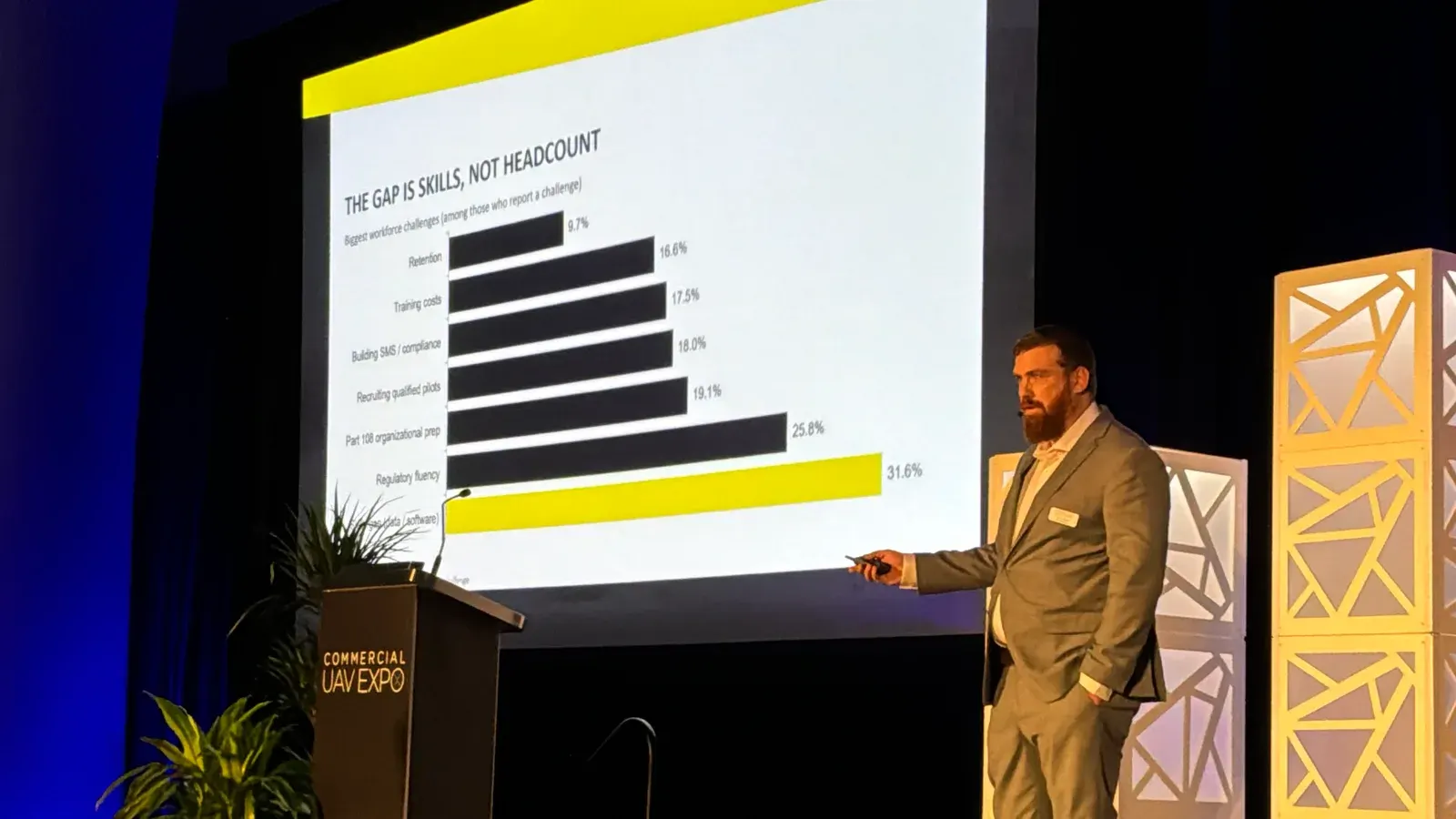
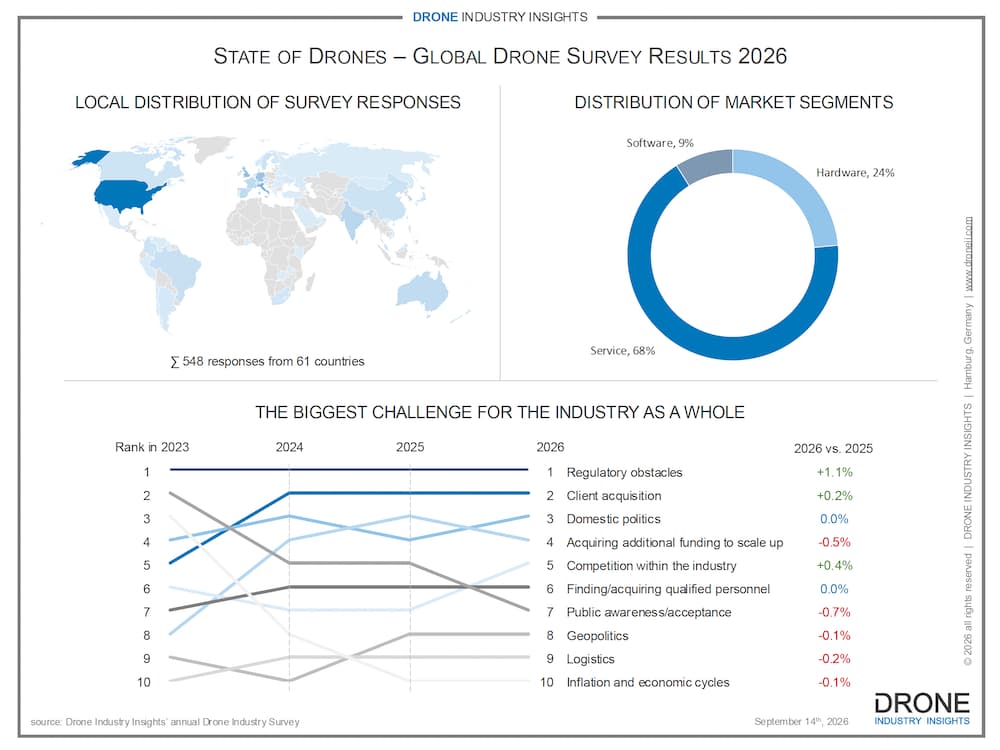
The annual Drone Industry Insights survey, now in its ninth edition, collected 548 responses in 61 countries between June and August 2026. It separates two scores out of ten: what companies expected from the market and what their sales actually delivered over twelve months.
In 2026, expectations stand at 6.7 and reality at 6.2. The 0.5-point gap is the smallest ever recorded by the survey.
This narrowing does not reflect resignation. It indicates that the companies that have come through the enthusiasm wave of the past decade are setting targets closer to their order books. Drone service providers, the category most exposed to flight authorisations, rate their reality at 5.7 and their expectations at 6.0.
Component manufacturers remain the most confident, with 7.0 for reality and 7.9 for projection.
Regulation remains the leading obstacle cited, for the ninth consecutive year, and the obstacle gains 1.1 points compared with 2025. The FAA published its proposed BVLOS rule, Part 108, in August 2025, followed by a 60-day public consultation.
More than a year later, no final rule has appeared. Greg Reverdiau, a contributor to the Pilot Institute, places finalisation in the first three quarters of 2027 and cites the Section 2209 rule on critical infrastructure as a possible source of harmonisation.
What the figures say about operators' actual activity

Revenue has not collapsed. Across all company sizes, 28.7% of companies report higher drone revenue or contract volume in 2025 than in 2024.
The base remains highly fragmented, however: sole traders and single-person operators account for 56.6% of the 885 respondents, organisations with two to ten people for 22.8%, and companies with more than fifty employees for 8.5%.
The composition of fleets explains part of the wait-and-see approach. 62.8% of respondents say that 76 to 100% of their active aircraft are manufactured by DJI or by another foreign manufacturer.
At the other end, 13.1% fly a fully domestic fleet.
Between the two, the distribution is almost empty: 6.7% fall in the 1 to 25% band of foreign aircraft, 6.5% in the 26 to 50% band. There is therefore almost no partial adoption, which leaves little room for a gradual transition.
Workforce difficulties confirm the diagnosis. Gaps in data and software come first at 31.6%, ahead of regulatory expertise at 25.8%, organisational preparation for Part 108 at 19.1% and recruitment of qualified remote pilots at 18%.
What they do not say: scope, fleet and timetable
The Covered List figures have a shelf life. The fieldwork for the Commercial UAV News and Pilot Institute survey closed before the FCC opened the procedure withdrawing import authorisation from drones already approved, and before the signing of Section 232 tariffs on imported drones.
The 45.8% of wait-and-see respondents are therefore the optimistic version of the situation, not its most recent snapshot.
The scope of the panel also limits the reach of the results. These are readers of a professional publication, not a revenue-weighted picture of the industry. The structure of the sample leans towards operators with the least capacity to absorb the replacement of a fleet.
Participation in global surveys is falling, which weakens year-on-year comparisons. Drone Industry Insights went from 964 responses in 94 countries in 2024 to 768 responses in 87 countries in 2025, then to 548 responses in 61 countries in 2026.
Europe accounts for 48% of respondents, North America 23%, Asia 15%. The United States, Italy, the United Kingdom and Germany supply most of the responses.
One question remains open in both surveys. Will morale hold if Part 108 remains blocked beyond 2027 and if FCC restrictions tighten? Neither survey provides an answer, and that is precisely what makes the indicator worth tracking before any commitment of fleet or capacity on the American market.
In Europe, FAA rules do not apply: Part 107 and the Part 108 in preparation fall under US law.
← Back to home · Search · Suggest a topic · Lire en français / Read in French