
Reviews — EU
Drone Industry Insights forecasts 83 billion for civil drones in 2035
An almost doubling of the civil market in ten years
Drone Industry Insights places the global civil drone market at 83 billion dollars in 2035. The firm anticipates an almost doubling of the market over the period covered by its 244-page report, which contains sector definitions and a ten-year forecast.
Drone Industry Insights is a specialist research firm: it does not manufacture drones and does not operate a fleet.
For a professional, this order of magnitude serves to calibrate a plan. An almost doubling in less than ten years provides a framework for investment in fleets, workshops and software, and for recruitment in the roles that follow growth.
The figure sets a sizing target, without saying which segments will capture the value.
3D printing moves beyond airframes, mounts and enclosures
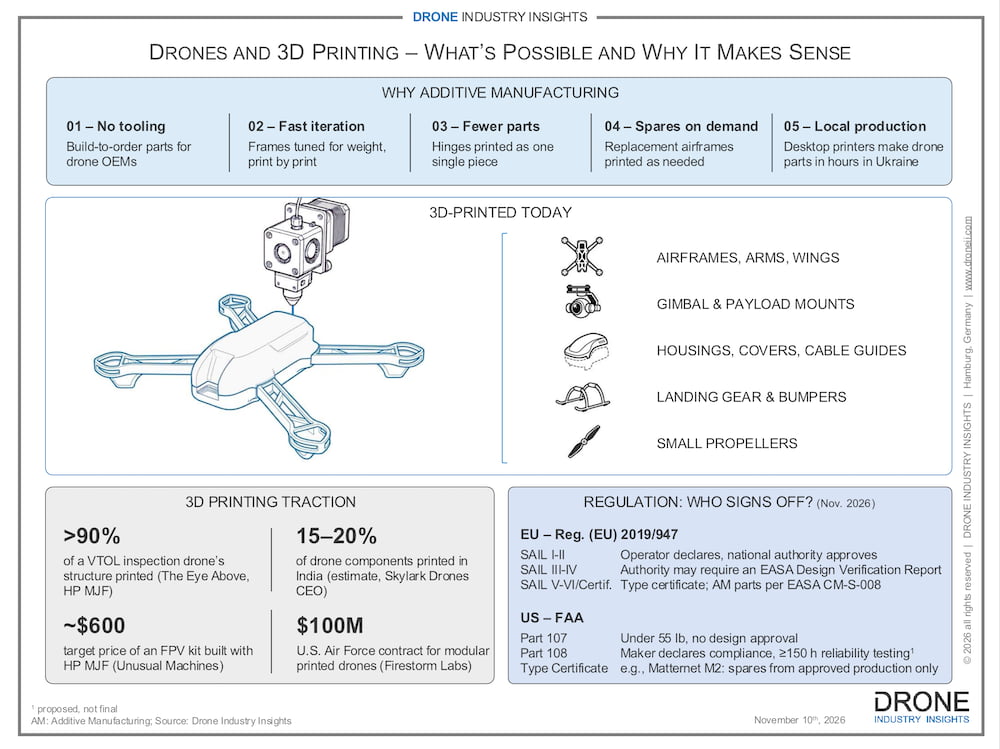
3D printing of drone parts has moved from prototypes to series production. Airframes, arms, fuselage, wing structures, gimbal and payload mounts, enclosures, cable guides, landing gear and bumpers come out of a printer.
Battery cells, motor windings, magnets, bearings, flight controllers, servos, sensors and cameras are not printed. A printer shapes a material; it manufactures neither battery chemistry, magnets nor semiconductors.
Material choice depends on the part. PA12 or PA11 polyamides are suitable for structural parts, flexible TPU absorbs crash loads, and carbon-fibre-reinforced nylon adds rigidity.
At Euro Defence Expo 2026 in Essen, hinges printed as a single piece were on display.
The same trade fair presented printing systems with build volumes of 12 and 42 litres for polymer parts, aimed at defence buyers.
In India, the head of Skylark Drones estimates that 15 to 20% of the country's drone components are 3D printed. FPV manufacturer Unusual Machines is targeting kits at around 600 dollars with printed parts.
Firestorm Labs prints replacement airframes and custom payload mounts on demand.
Inspection drone manufacturer VTOL The Eye Above prints more than 90% of its structure. These practices reduce tooling and speed up iteration; electronics, propulsion and sensors remain outside the printer's scope.
The European Regulation 2019/947 and the US Part 108 rule
In the European Union, Regulation (EU) 2019/947 modulates requirements according to risk. For higher-risk operations in the specific category, authorities may require an EASA Design Verification Report.
Certified operations require a type certificate.
EASA's CM-S-008 certification note sets out expectations for additively manufactured parts. These rules weigh on investment in 3D printing: a printed part must fit into a compliance dossier.
In the United States, the proposed BVLOS rule known as Part 108 would allow manufacturers to declare conformity with accepted consensus standards. It was not final in November 2026.
BVLOS, Beyond Visual Line of Sight, refers to flight beyond the remote pilot's direct sight, which requires specific authorisation or risk mitigation.
The difference between a proposed rule and a final rule changes a programme's timetable, especially for printed structural parts.
The share of services and software is not quantified
The 83 billion dollar forecast does not provide a breakdown between hardware, services and software. If printed hardware falls in cost, the relative value of services, maintenance, data and flight software increases.
Drone Industry Insights lists more than 7,200 products and services across all domains and offers ASTRA Intelligence, a drone and mobile robot platform announced as 100% free. These tools broaden visibility of the offering without settling the value split.
An investment plan therefore treats the market forecast as a growth framework and the services and software share as a hypothesis to be tested, segment by segment.
← Back to home · Search · Suggest a topic · Lire en français / Read in French