
Regulation — EU
DJI releases Matrice 4 firmware with regulatory changes
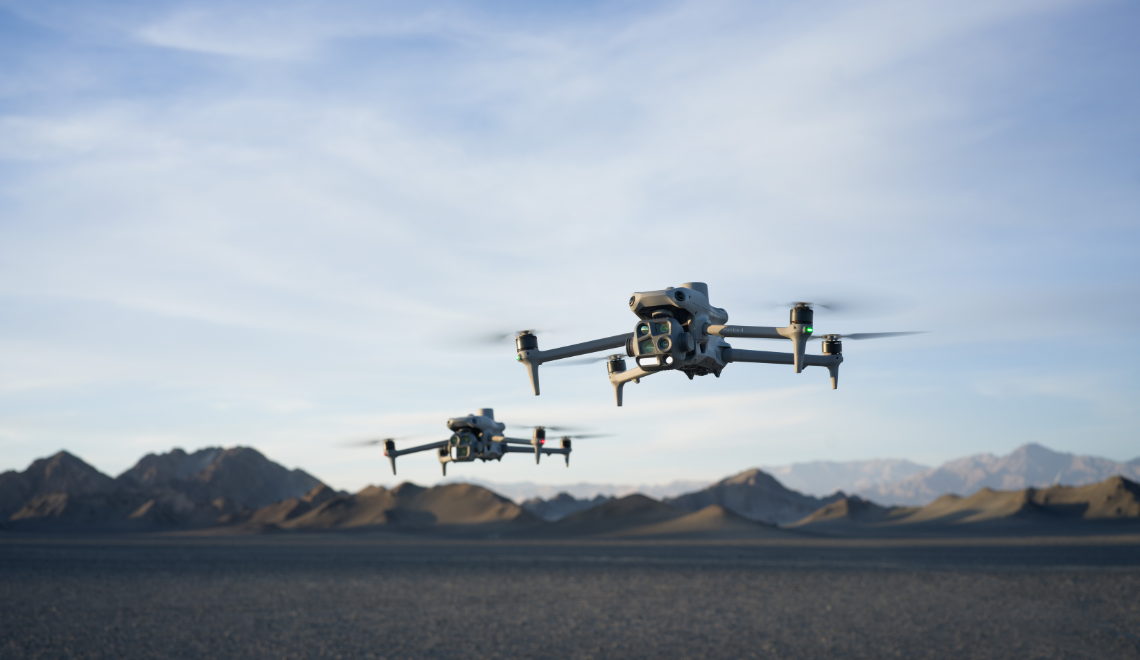
The version numbers to check before take-off

The release notes dated 5 November pair aircraft firmware v19.01.00.07 with that of the RC Plus 2 Enterprise remote controller, at v19.01.00.08, and with DJI Pilot 2 v19.1.0.45.
The package does not stop at the aircraft: the DJI AS1 speaker moves to v01.00.01.11, the AL1 spotlight to v01.00.29.85, the D-RTK 3 station to v17.01.05.02 and the DJI O4 ground station to v19.01.00.58.
Four peripherals, four distinct numbers, to be checked separately from that of the airframe.
The numbering has skipped a step. The previous release, dated 10 July, carried aircraft firmware v17.02.05.01. The series then jumps straight to 19.01.00.07, with no version 18.
One documented device moved from an earlier version to v19.01.00.07 without the May (v17.01.05.16) and June (v17.02.05.01) releases having been installed.
Across a fleet of several aircraft, the gap between two devices can therefore be wider than the version displayed in the app alone would suggest.
What the regulatory changes cover
DJI announces changes linked to regulation, accompanied by bug fixes. The published material does not specify which regulatory parameters change, nor how they alter the flight behaviour of a device already in service.
The question remains open: the exact list of affected settings and their effect on existing flights have not been established.
The Matrice 4 series is C2-certified by EASA, according to DJI's product sheet. This classification ties the device to a European framework in which the onboard parameters count as much as the configuration declared by the operator.
Firmware that touches these settings therefore requires a check after installation, device by device, before setting out on an operation again.
Platform, activation and integration into the workflow
Installation goes through the RC Plus 2 Enterprise. On first use, the remote controller connects over Wi-Fi or via a connection share from a smartphone, then activation is done in DJI Pilot 2, which is also used to pair the aircraft.
Version 19.1.0.45 of the software is part of the same package, which aligns the app and the firmware in a single step.
RTK flights, that is corrected in real time by centimetre-level positioning, rely on the D-RTK 3, whose firmware also changes here. The DJI O4 ground station link follows the same pattern.
For an operation that runs mission after mission, the update is handled as a fleet operation: record the version of each aircraft, each remote controller and each accessory before departure, log the result, and review the situation after installation.
Spotlights and speakers update separately and can remain behind without anything flagging it at take-off.
Operators concerned and precautions
The series comes in two versions. The Matrice 4T carries a 48 MP 1/1.3-inch wide-angle camera, a 48 MP 1/1.3-inch medium telephoto, a second 48 MP 1/1.5-inch telephoto, a thermal camera, NIR lighting and a laser rangefinder.
The Matrice 4E makes do with a 20 MP 4/3-inch wide-angle, the two telephotos and the rangefinder, for imaging and mapping.
These configurations put the series on public safety, inspection and geomatics missions. These are also the contexts where a change in a regulatory parameter has the most consequences: flight near people, restricted zones, night-time operations.
For these uses, the onboard version becomes a piece of mission planning data, just like the area and the weather. A device still showing v17.02.05.01 does not fly in the same configuration as one on v19.01.00.07, and nothing in the published material today allows one to state that the gap is neutral.
← Back to home · Search · Suggest a topic · Lire en français / Read in French