
Regulation — FR
In the Antilles, drone spraying in banana plantations faces a legal challenge
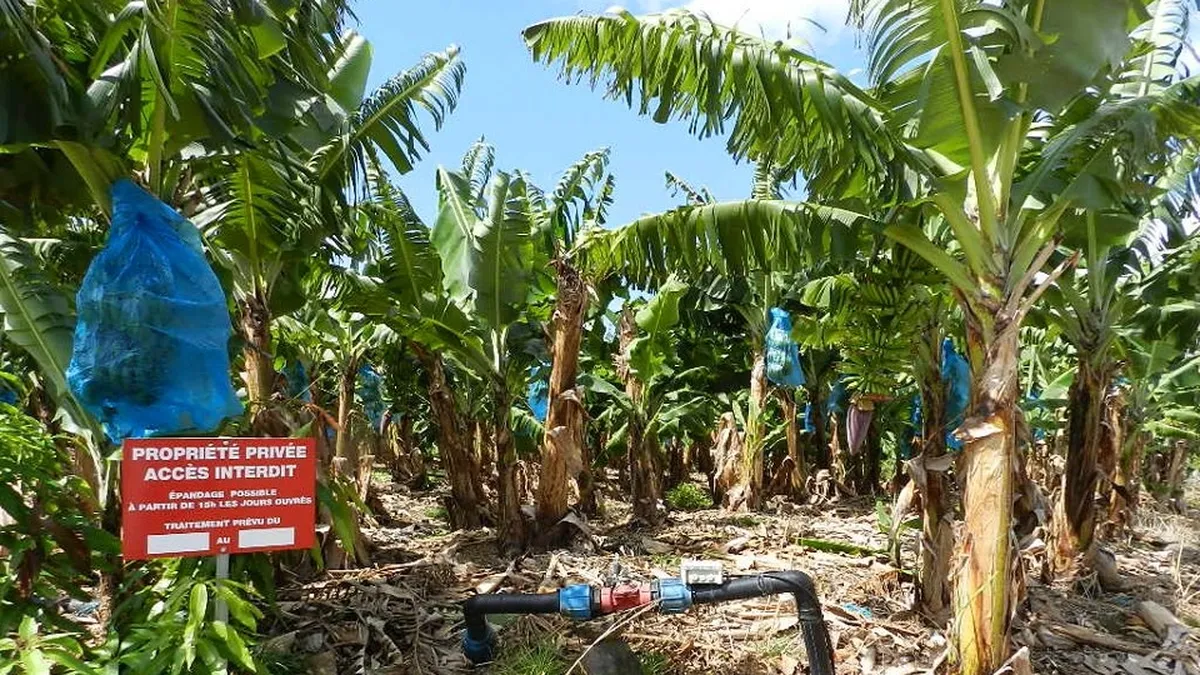
In Lamentin, a legal challenge against a return of aerial spraying
In Lamentin, Guadeloupe, Emilie Bouchet, 41, lives surrounded by sugarcane fields. “Aerial spraying by drone? But the courts have not even finished with chlordecone yet!” In mid-September, five environmental associations — Asfa, Amazona, Aeva, Vivre and Toti-Jon — filed legal challenges before the Council of State against a decree and two orders.
These texts, adopted under the law of 23 April 2025, authorise drone spraying in banana plantations or on plots with a slope of more than 20%. For now, only biocontrol, organic or low-risk products are permitted.
“What is low-risk today, tomorrow we don’t know,” warns Béatrice Ibéné, a veterinary surgeon and president of Asfa, who fears cocktail effects with pesticides that persist in the soil.
Aerial spraying has been banned in France since 2014. She refuses to let the practice return via drones. The associations base their challenge on Anses, which considers the three trials conducted in Martinique too weak to guarantee the safety of local residents.
In Martinique, water-only trials before actual treatments
“This is the future for tackling black sigatoka!” says Jean-Claude Marraud des Grottes, president of Banamart, a banana growers’ cooperative. The first flights sprayed only water.
The group hopes to launch the actual trials on 1 January 2027, with a target of 30 to 35% fewer products. It is considering around fifty drones and is coming up against a rule on the nozzles that disperse the product.
In Guadeloupe, nothing has taken off. At the Directorate for Agriculture, Ramon Taae, head of the food department, confirms that no authorisation application has been submitted. Professionals are taken up by a severe drought, explains Philippe Aliane, director general of the group Les Producteurs de Guadeloupe.
He welcomes a step forward, awaits the outcome of the legal challenges and raises a profitability question: should they finance both a tractor and a drone?
What the drone changes compared with the tractor
The drone completes the work in under an hour. Banana plantations cover 6,000 hectares, 1,700 in Guadeloupe and 4,300 in Martinique, and generate 160 million euros in annual revenue.
The precision of the machine is used as an argument by Jean-Claude Marraud des Grottes, who ultimately calls for the spraying of conventional chemical treatments. The five associations consider this prospect unacceptable.
Farmers’ calculations include depreciation of the dual equipment, tractor and drone. In Guadeloupe, the drought weighs more heavily than the technological trade-off. In Martinique, black sigatoka gives the drone a rationale that producers consider decisive.
What can be replicated, what cannot be transposed
The texts adopted under the law of 23 April 2025 cover banana plantations and plots with a slope of more than 20%, with a list of products restricted to biocontrol products, organic products and low-risk products.
A farm outside these two situations cannot rely on them.
In Guadeloupe, the five associations’ legal challenge and the memory of chlordecone are blocking applications. In Martinique, black sigatoka pushes producers to move forward, which does not remove the associations’ reservations.
The nozzle issue has not been settled, while the group is aiming for 1 January 2027 for the actual trials.
What cannot be transposed is context-specific: a drought that diverts attention, a banana sector worth 160 million euros, a disease that encourages reducing treatments. A cereal or market-gardening farm will not find the same arguments there.
The question of authorisations remains before the Council of State. In Guadeloupe, the Daaf has no applications to process.
← Back to home · Search · Suggest a topic · Lire en français / Read in French