
Professional applications — US
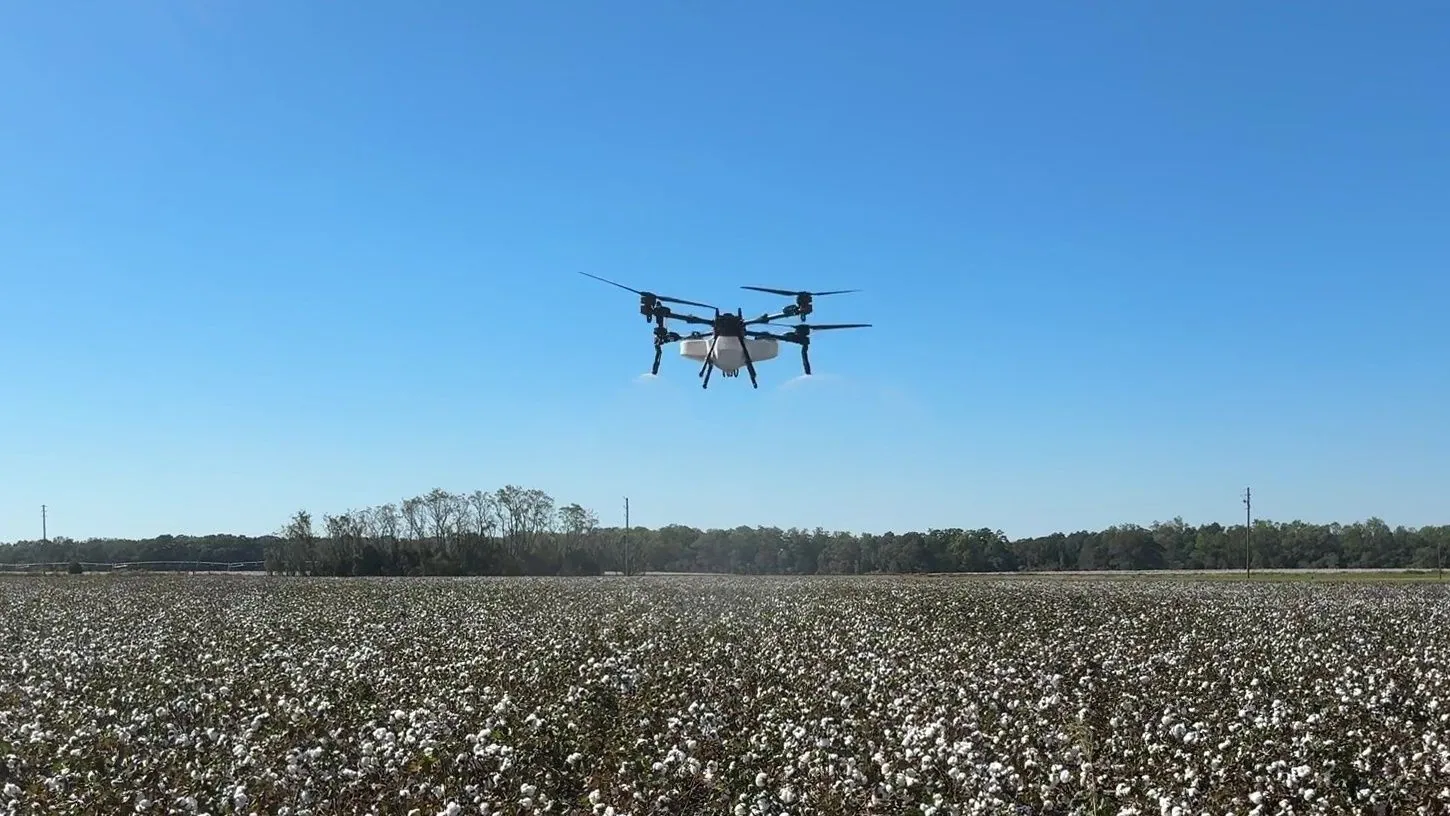
Auburn: a drone defoliates cotton at 3 gallons per acre
Moving to 3 gallons per acre was enough
Across the four site-years of the trial, defoliation, desiccation, regrowth and boll opening came out comparable between the two drone volumes and the ground pass. The drone therefore held at 3 gallons per acre (28 litres per hectare), two gallons below the aerial minimum in the cotton defoliation guide published in 2020 by the Alabama Cooperative Extension System.
That guide calls for at least 15 gallons per acre on the ground and 5 by air. The trial's ground sprayer was also running below the guide's ground figure, at 10 gallons per acre (94 litres per hectare), with the same three-product defoliant mixture.
One caveat remains. In one of the four site-years, the plots treated by drone showed higher desiccation. Simer Virk, a precision agriculture specialist at Auburn, suggests environmental conditions or other factors.
The cause was not established.
Four site-years on cotton, in randomised plots
The trials took place in Alabama in 2024 and 2025, on large randomised field plots. Visual ratings were made 10 to 14 days after application, according to the abstract Shubhdeep Singh, of Auburn, submitted for the CANVAS 2026 conference.
The drone flew a three-way defoliant mixture at 3 and 5 gallons per acre (28 and 47 litres per hectare).
The same mix went out on the ground at 10 gallons per acre.
Virk reported these results on 16 November in a column for Farm Press. The set-up remains that of a university trial conducted on one crop and one region, not a multi-site protocol.
Coverage measured with water-sensitive paper
Auburn measured coverage at the top, middle and bottom of the canopy, using water-sensitive paper placed in the crop cover. The drone remained behind the ground sprayer at all three levels.
Virk explains this by the higher volume of the ground machine and by a boom that passes closer to the plants.
Consistency across the working width also counts: a boom carries evenly spaced nozzles, whereas the drone deposits a bell-shaped curve that remains variable even where two adjacent passes overlap.
The rotor downwash does push the spray into the canopy, but the effect fades when the drone flies higher or faster.
Going up to 5 gallons per acre improved coverage, especially at the top of the plant. Virk writes that adding 1 to 2 gallons per acre, which he presents as a 50% or 100% increase for a drone, can improve coverage, canopy deposition and efficacy.
What carries over from one job to another, and what does not
The 2020 guide does not mention drones, and Virk refers to the product label for the spray volume to apply. His column gives the direction of the results and no result figures: no coverage percentage, no yield, and the machine used is not named.
The abstract states that the data from both years were still being analysed when it was submitted. Nothing indicates that these results hold on other crops, nor under what wind conditions they remain valid.
In the United States, access to equipment remains a job-by-job variable. Laramie Adams, of the Texas Farm Bureau, said in January that many of the drone systems on American farms are foreign-made, and the FCC decision on the Covered List of December 2025 blocks the approval of new foreign models.
That framework says nothing about the rules applicable in Europe, where FAA rules do not apply.
For an operator, the argument rests first on logistics: at 3 gallons per acre against 10, the number of refills and the water hauled per pass fall in the same proportions.
Cost per pass will follow, provided the coverage obtained remains sufficient on the target crop and the product used allows that volume.
← Back to home · Search · Suggest a topic · Lire en français / Read in French