
Incidents — UK
MoD deploys RAF to Jersey after drone incursions
Night-time closures at Jersey Airport
Between 30 and 31 October 2026, unauthorised drone incursions caused consecutive night-time closures of Jersey Airport's airspace. The first disruption began at 20:20 on Friday 30 October, when repeated sightings of drones within regulated approach paths interrupted operations for more than two hours. Regional air traffic was heavily disrupted. The UK Ministry of Defence confirmed the deployment of the Royal Air Force to Jersey under a MACA request. The characteristics of the aircraft, their origin and the outcome of the neutralisation operations have not been established.
A MACA request and a military framework
The MACA request places the intervention within a framework of military aid to the civil authorities. The MoD confirms the deployment without specifying the assets committed or the results obtained. This classification distinguishes the official announcement from what remains to be verified: the nature of the aircraft, the number of devices, the exact duration of the closures and the effect of the neutralisation measures. For an airport, the reporting of a drone in an approach path is enough to trigger a halt to operations, as the sequence of 30 October showed. The state response can mobilise military assets without the incident being classified as an attack. In Jersey, no official source has established that the devices were hostile or that they belonged to an identified operator.
American precedents and detection assets
In the United States, FEMA has announced $250 million through its Counter-Unmanned Aircraft Systems grant programme for fiscal year 2027. This funding covers the detection and protection of infrastructure. ANRA Technologies has moved its SIOP and TACO software from Technology Readiness Level 5 to Level 7 after NATO and US Army interoperability exercises. The TACO system, presented in a transportable case, deploys in less than 15 minutes and has been tested with up to 10 sensors connected simultaneously and 100 targets tracked. Other equipment claims up to 4.5 hours of endurance, with an external power supply of 12 to 28 V.
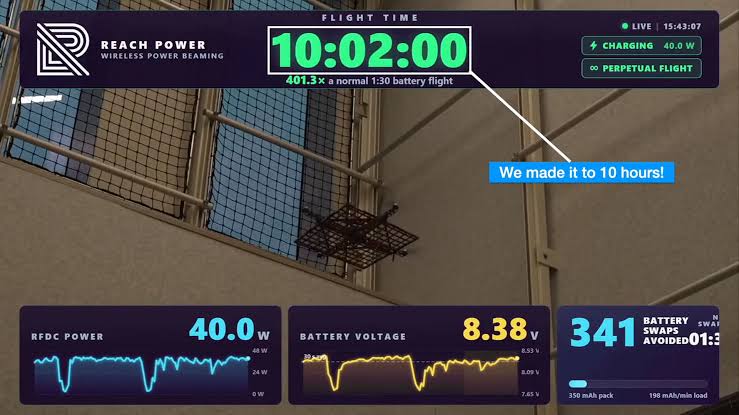
On the industrial side, Destinus has announced production of its 1,750th Ruta B1 cruise missile, with a monthly rate close to 300 units. Primoco UAV has reported a 69% increase in revenue over nine months and a 246% rise in EBITDA. Reach Power has sustained a 10-hour autonomous flight, around 400 times the 90-second endurance of the battery in the configuration tested. The demonstration took place on 22 September at the Virginia Tech Institute for Advanced Computing, as part of Operational Energy-Innovation's Energy Sentry 2026 event. Reach says the demonstration was streamed live to participants at the Pentagon. In Westborough, a local vote rejected an Amazon proposal by 510 votes to 13. These elements do not document the Jersey incident, but they show the range of detection, endurance and production assets surrounding the response to drones.
Preparing a sensitive airport area
For an operator, the Jersey sequence is a reminder that coordination with the airport and state services must be established before the incident. A report in an approach path can close the airspace for more than two hours. RF detection is not enough to identify the aircraft. The systems claim four-band scans in 4 to 8 seconds, from 1080 to 2200 MHz, 2870 to 4500 MHz, 4890 to 6040 MHz and 6050 to 8800 MHz. The addition of the 6.05 to 8.8 GHz band, compared with Chuyka 3.0, broadens coverage of the signals used by FPV drones and fixed-wing UAVs. Neutralisation is not documented in Jersey. The origin of the devices and the outcome of the operations remain unknown. An operator must therefore prepare procedures that distinguish detection, identification and intervention, without presuming the nature of the aircraft.
← Back to home · Search · Suggest a topic · Lire en français / Read in French