
Regulation — EU
CEN publishes three standards on geocaging and flight termination
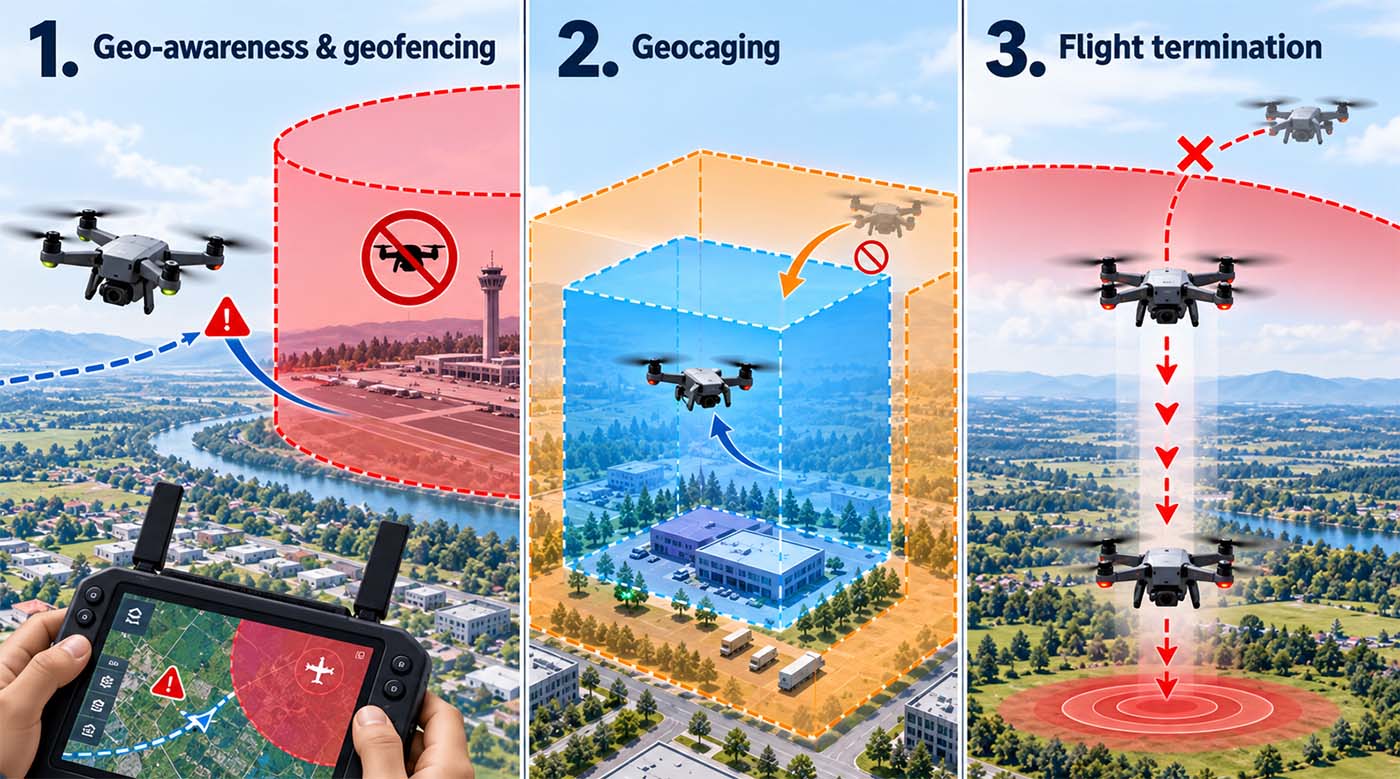
Three CEN standards for geo-awareness, geocaging and flight termination

The European Committee for Standardization (CEN) has published three technical standards for drones: EN 4709-003:2026, EN 4709-005:2026 and EN 4709-006:2026. They were developed by CEN/TC 471, the technical committee responsible for unmanned aircraft systems. They cover geo-awareness, geocaging and flight termination systems (FTS).
These texts provide manufacturers with detailed technical requirements and test procedures. They describe how to demonstrate that a drone recognises airspace restrictions, remains within the limits of an authorised zone and interrupts a flight when continuing the mission is no longer safe. The three functions primarily concern aircraft operated in the Specific category.
The three standards belong to the EN 4709 series, which covers several aspects of unmanned aircraft systems, including product requirements, remote identification and lighting. They are not regulations: the legal framework remains Delegated Regulation (EU) 2019/945 of 12 March 2019 on unmanned aircraft systems and on third-country operators, which sets the requirements applicable to products placed on the European market.
Geo-awareness, geocaging and flight termination: three distinct functions
The three concepts overlap without being the same. Geo-awareness is an information function: embedded in the drone, it warns of prohibited or restricted zones. EN 4709-003:2026 sets out its conditions: loading of geographical information, presentation of warnings to the remote pilot, verification that the alert occurs early enough to allow time for corrective action before entering the zone. Automatic geofencing is among the optional functions covered, with an explicit caveat: the remote pilot must retain the ability to intervene.
EN 4709-005:2026 covers geocaging, which defines the three-dimensional volume within which the drone is authorised to operate. The standard deals with static geocaging and particularly concerns class C6 drones. It distinguishes the flight geography, where the normal operation takes place, and a contingency volume surrounding it, intended for corrective manoeuvres in the event of a deviation from the trajectory. The limits are programmed before take-off. The drone must reject unsuitable flight plans, including routes or landing points located outside the authorised flight geography. In flight, it continuously monitors its position relative to these boundaries. An exit from the flight geography triggers an automatic contingency procedure and an alert to the remote pilot. The system attempts to bring the aircraft back into the intended zone without crossing the outer limits of the operational volume. If these outer limits are exceeded, flight termination must be triggered.
EN 4709-006:2026 specifically governs this termination. The FTS provides a means of ending the flight when its continuation presents an unacceptable risk. It covers the requirements applicable to class C5 and C6 aircraft. Activation may be manual, at the remote pilot's initiative, or automatic depending on the system.
What an operator can include in an authorisation file
For an operator in the Specific category, the interest is documentary. The three standards provide a common vocabulary and test procedures to describe what the drone can do in terms of containment and flight termination. A file that cites these references uses the vocabulary of manufacturers and evaluators.
The concrete procedure remains that of the existing framework: declaration or authorisation under Implementing Regulation (EU) 2019/947, depending on the type of operation. No new administrative formality is described in the published texts. A manufacturer targeting the European market must comply with the requirements of Delegated Regulation (EU) 2019/945; the EN 4709 standards provide the method for demonstrating this compliance on the three functions concerned. The operator has a point of reference for checking that the technical documentation of its aircraft covers geo-awareness, geocaging and flight termination, and for describing their limits in its risk analysis.
Implementation timetable and relationship with Regulation 2019/947
The date of application of the three standards and their relationship with Regulation (EU) 2019/947 remain to be specified. The published texts set technical requirements and test procedures; they do not provide an implementation timetable. The penalty regime in the event of non-compliance is also not specified.
Compliance with the EN 4709-003, -005 and -006 standards is a matter of the manufacturer's technical demonstration. The authorisation regime still depends on Implementing Regulation (EU) 2019/947 and on the conditions set by the competent authority. The European Commission adopted the common technical rules for Union drones as early as 2019 and provided for texts covering operations, from flights without prior authorisation to operations with certified aircraft and operators.
← Back to home · Search · Suggest a topic · Lire en français / Read in French