
Regulation — EU
Estonia: 2026-2030 drone roadmap co-built with industry
The status of the 2026-2030 roadmap project

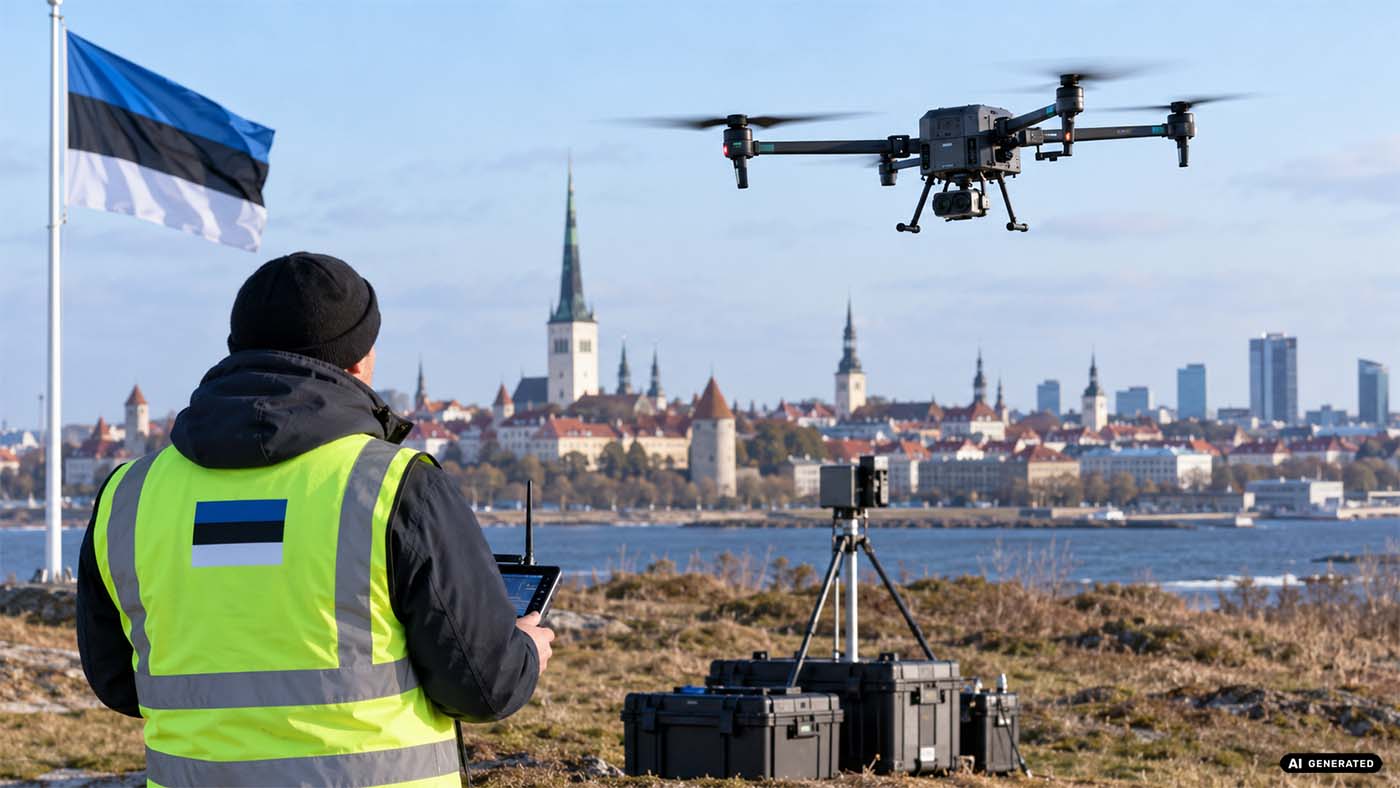
The Estonian 2026-2030 uncrewed systems roadmap project is a working document co-created with industry. It is not legally binding at this stage. It aims to accelerate the development, testing and deployment of drones. The Estonian Government Office coordinates the initiative and has convened the steering group responsible for the roadmap. Andy Viikmaa, CEO and founder of TrackDeep.ai and a board member of the Estonian Aviation Cluster, took part in the discussions.
The target period is 2026-2030. No entry-into-force date is public. A new aviation law is being prepared under the responsibility of the Ministry of Climate; its adoption is not guaranteed. As of 28 October 2026, no text applicable on this basis has been published in Estonia. The plan may announce priorities and tools. It does not set flight rules in force.
The exact scope remains broad. The roadmap refers to uncrewed systems without separating professional civil uses, defence, internal security and aviation security. For a civil operator, this absence of a boundary means that the announced framework conditions also concern dual-use activities. It does not allow the conclusion that the same rules will apply to all.
The 2026-2030 timetable and the aviation law
The 2026-2030 uncrewed systems roadmap was published in June 2026. It is presented as a coordination framework between the government, private companies and academia. A booking platform for test sites is announced for 2026. The aviation law, led by the Ministry of Climate, is intended to address regulatory bottlenecks and establish a more flexible framework for the development, testing and deployment of new aeronautical technologies. No public parliamentary timetable accompanies this law. At this stage, no public consultation, opinion or delegated act is announced for this text.
A status report published on 15 July 2026 shows that European governments are multiplying announcements on drones. NATO presented an initiative intended to invest more than $40 billion in counter-drone capabilities over five years. Germany launched an order for 50,000 drones for Ukraine. The United Kingdom reserved billions of pounds for drones and counter-drone systems. The start-up Helsing reached a valuation of $18 billion. McKinsey indicates that transaction volumes more than doubled year on year and that European funding for defence technologies rose from about €200 million in 2021 to €2.6 billion in 2025.
Baseline European defence spending has doubled since 2019. With the NATO target of 3.5% of GDP for 2035, it could reach about €800 billion in 2030, or nearly 2.9% of GDP, according to McKinsey. This trend does not determine the content of the Estonian roadmap. European operators follow national testing and permit frameworks, which determine the speed of market entry.
The quantified conditions absent from the roadmap
The Estonian roadmap sets no height, no mass, no drone class and no operating distance. It gives no threshold for urban areas, sensitive sites or beyond visual line of sight flights. The only quantified horizon is 2030. The stated objective is to raise aviation's contribution to Estonian gross domestic product to at least 4%, in order to get closer to the European average.
The roadmap identifies access to test sites, simplification of permits, modernisation of aviation legislation and cooperation between agencies and companies. A platform is to be launched in 2026 to allow companies to book drone test sites. It is to help developers find a location suited to their needs and reduce the time needed to organise test flights.
The text also positions the State as first customer. Andy Viikmaa advocates public procurement of innovation based on operational requirements and measurable results. He rules out imposed technical solutions. The authorities could evaluate systems in real conditions and help companies build operational experience before export. This point concerns companies seeking a public customer in addition to a test site.
The law, test sites and data sharing
The precise content of the roadmap and its legislative timetable are not public. The new aviation law has not been adopted. Responsibilities between agencies, the sharing of detection data and the rules for access to test sites remain to be specified. The roadmap provides for a shared picture of low airspace, with sensors capable of exchanging data for defence, internal security, aviation security and critical infrastructure protection. Liability and cooperation agreements still need to be established.
On 1 September 2026, a drone crossed Latvia before briefly entering Estonia during a drone attack against the Russian port of Ust-Luga. The authorities have not established a direct link between this drone and the strike. Reuters indicated that the port loaded about 700,000 barrels of crude per day and had exported 32.9 million tonnes of petroleum products in 2025. Estonian foreign intelligence documented Russian production of 3.4 million artillery shells, 800,000 munitions for tanks and infantry fighting vehicles, 2.3 million mortar shells and 500,000 rockets for multiple launch rocket systems in 2025. Since 2021, Russian artillery production has increased 17-fold, from 400,000 to 7 million shells, mortars and rockets. Estonian foreign intelligence puts the cost of a 152 mm shell at about €1,050 in public procurement, several times less than a 155 mm shell produced in the West.
These data do not set the flight conditions for civil drones in Estonia. The roadmap provides for low airspace surveillance and coordination between public and private actors. The open points remain the publication of the final text, the submission of the aviation law, the arrangements for booking test sites and the rules for sharing detection data. None of these steps has a public date apart from 2026 and the 2030 horizon.
← Back to home · Search · Suggest a topic · Lire en français / Read in French