
Software & services — DE
AirSight adds RF detection analysis to its AirGuard platform
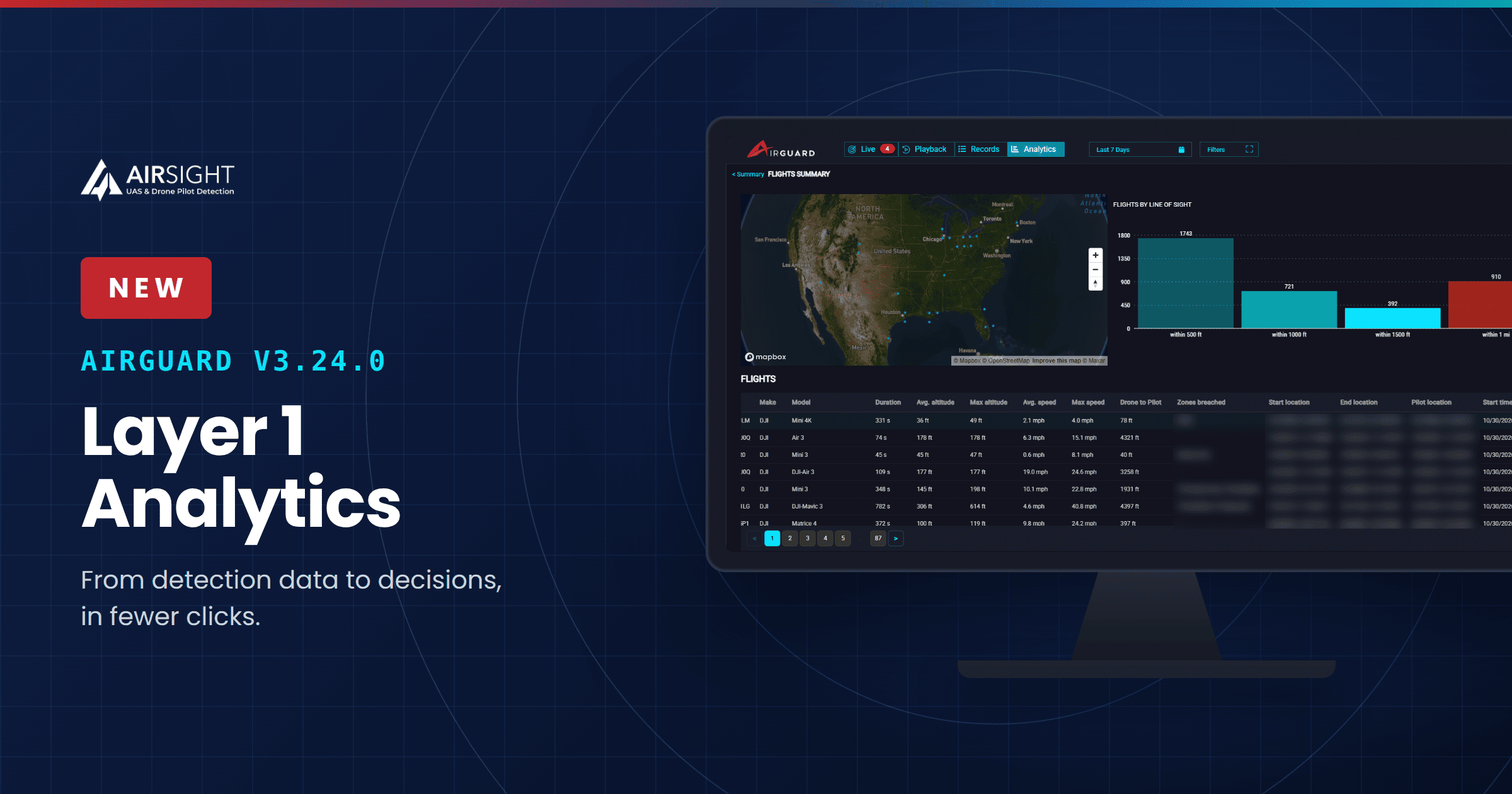
Linked Models, Drones and Flights reports
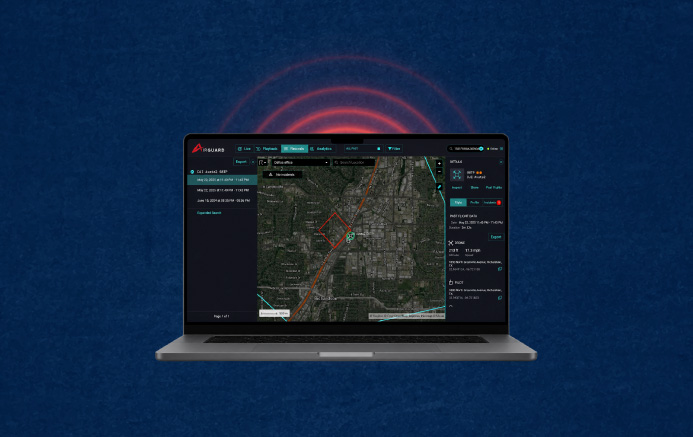
AirSight is adding to AirGuard, its drone detection software platform, analytics tools built for its radiofrequency detections, which it designates as layer 1 of the system. An agent starts from a suspected drone model, opens the list of aircraft of that model, then that of their flights, and finishes by reviewing one specific flight.
No filter has to be re-entered between two steps.
The whole thing comes down to three reports, Models, Drones and Flights, which call one another. Four charts are added to them. Top Offenders ranks drones by the number of alert-zone crossings.
Flights by Time Window splits activity into four periods, 6am-6pm, 6pm-9pm, 9pm-midnight and midnight-6am. Flights by Line of Sight groups flights according to the distance between the drone and its pilot, from under 500 feet to over one mile.
Flights per Max Altitude distributes them by bands, from 100 feet to over 800 feet. A PDF export takes the result out of the platform, whereas until now analyses were rebuilt outside it.
Officials from the Department of Justice and the FBI testified that drone incidents in US federal prisons rose from 23 in 2018 to 479 in 2024. The vendor picks one case to illustrate the value of its charts.
On 24 June, federal prosecutors in Georgia made public an indictment against twelve people, which the US Attorney's Office for the Middle District of Georgia presents as the largest federal prosecution to date for contraband coordinated by drone into prisons.
The indictment alleges the use of six drones for at least 38 drops in ten federal facilities between September 2023 and May 2026, night-time drops according to CNN. AirSight claims that finding this regularity by hand requires weeks of sorting through spreadsheets.
Airports, stadiums and prisons, where sorting alerts changes usage
Detection produces more reports than the eye does. In a test at Los Angeles airport, the TSA indicated around 90 visual observations against nearly 5,200 technical detections within a three-mile radius, between 2021 and 2022.
A site that has only visual counts is working on a small fraction of its real traffic.
US airports are still recording cases. The public registers of the FAA list 568 of them from July to September 2026. On 17 September, the FAA suspended departures from Reagan National Airport for around twenty minutes, after two crews reported a drone near a runway.
Reuters reports that the FAA indicated that an Airbus A321 pilot had reported a collision at around 3,000 feet on final approach.
Stadiums follow the same profile. The NFL told Congress it had counted 2,845 drone incursions into the airspace of its venues in 2023, and a drone interrupted a play-off game in Baltimore in January 2025, according to DroneXL.
During the 2026 World Cup, the FBI and the Department of Homeland Security seized more than 700 drones in restricted airspace in eleven US host cities.
RF detections alone do not cover drones without a link
The announced tools cover the RF layer. A consumer drone that connects to its radio controller emits in the 2.4 and 5.8 GHz bands, and this signature makes it possible to identify it.
The radio link also gives the pilot's position, which separates an intruder from background noise and directs an intervention.
An aircraft flying without a link, on a pre-programmed mission, emits nothing. AirGuard handles this case through other layers, radar with automatic classification and continuous human verification, but the vendor does not specify whether the new analytics reports extend to radar tracks.
The accuracy of identification against autonomous drones or drones deprived of an RF link therefore remains an open question.
Detecting does not mean authorising neutralisation. The vendor itself describes a gap between detection and intervention, the latter presupposing a legal basis that the platform does not provide.
Open architecture, multiple sensors, licences not disclosed
AirGuard is software, deployed with the sensors that the site chooses. Detection combines Remote ID and geolocation, RF and directional RF, radar, PTZ cameras and continuous human verification. For airports, an ADS-B view of manned aircraft can be displayed alongside the drones.
The platform connects to systems already in place: video surveillance, perimeter security, access control, physical security teams, compliance reporting. Prices and licence terms have not been disclosed.
The compliance framework highlighted is American, FAA and DHS. FAA rules, Part 107 and Part 108 in preparation, do not apply in Europe, where the reference framework is that of U-space services.
In market terms, global spending on counter-drone systems exceeded $53 billion over the first eight months of 2026.
← Back to home · Search · Suggest a topic · Lire en français / Read in French